In Simple Words
Receiving a text alert that a doctor's checkup is due reminds a person of the task, but they must still dial the clinic to schedule it. Having the receptionist call and ask 'Would you like to book for Tuesday at 10 AM?' eliminates the act of making the call. A reminder refreshes memory; proactive initiation removes the active threshold to act.
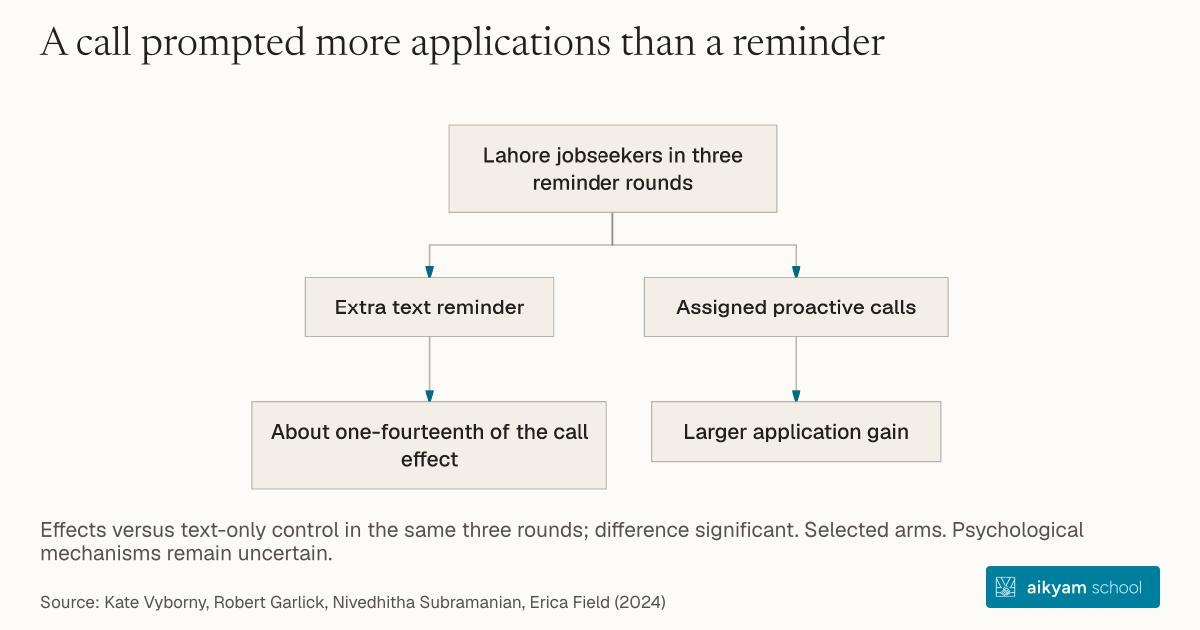
Lahore jobseekers in three reminder rounds
- Extra text reminder
- About one-fourteenth of the call effect
- Assigned proactive calls
- Larger application gain
Effects versus text-only control in the same three rounds; difference significant. Selected arms. Psychological mechanisms remain uncertain.
See source →Research question
Policy interventions frequently combine reminders, information provision, and process modifications, obscuring whether individual behavior shifts stem from memory nudges or from reducing active step-initiation thresholds.
Participants
N = 9,838 jobseekers across multiple experimental sub-rounds in Lahore, Pakistan.
Study Design
Multi-arm RCT comparing interactive phone-call initiation against passive text reminders (Table C.4), free callback reminders (Table C.3), and variations in call timing and deadline length.
Results
Sending a text message reminder produced an application increase 1/14th the size of proactive phone call initiation (p < 0.001). Free callback salience produced an effect 1/100th the size (p = 0.017), and initiating calls later in the application window reduced treatment impact (-0.072 percentage points per day, p < 0.001).
Takeaway
Re-architect public benefit and program delivery workflows to replace passive reminders with default interactive initiation prompts that complete action steps on behalf of users.
Source and citation
See source →Read alongside the research
Plain-English glossary
Original explanations, informed by the references below. Examples are illustrations, not data from the studies above. The research text stays unchanged.
- Percentage points
The difference between two percentages.
ExampleA rise from 40% to 50% is 10 percentage points. Relative to the starting value, that is a 25% increase.
Office for National Statistics · Percentages ↗Read more about percentage points →- Randomized controlled trial
A study that uses chance, like drawing lots, to decide who receives each option being compared. Researchers compare the groups’ outcomes to estimate the effect of those options.
ExampleA lottery assigns volunteers to a training programme or a comparison group. Researchers then compare their outcomes.
GET-IT glossary · Randomized study ↗Read more about randomized controlled trial →