In Simple Words
Imagine choosing a first car. You might worry about three distinct opinions: whether your friends think it looks cheap (social judgment), whether a future buyer will think it is worthless (professional dead-end), and whether driving it makes you feel unhappy with yourself (personal disappointment). Reassuring someone that their family will respect the vehicle does not fix their fear that future employers will view it as a career dead-end.
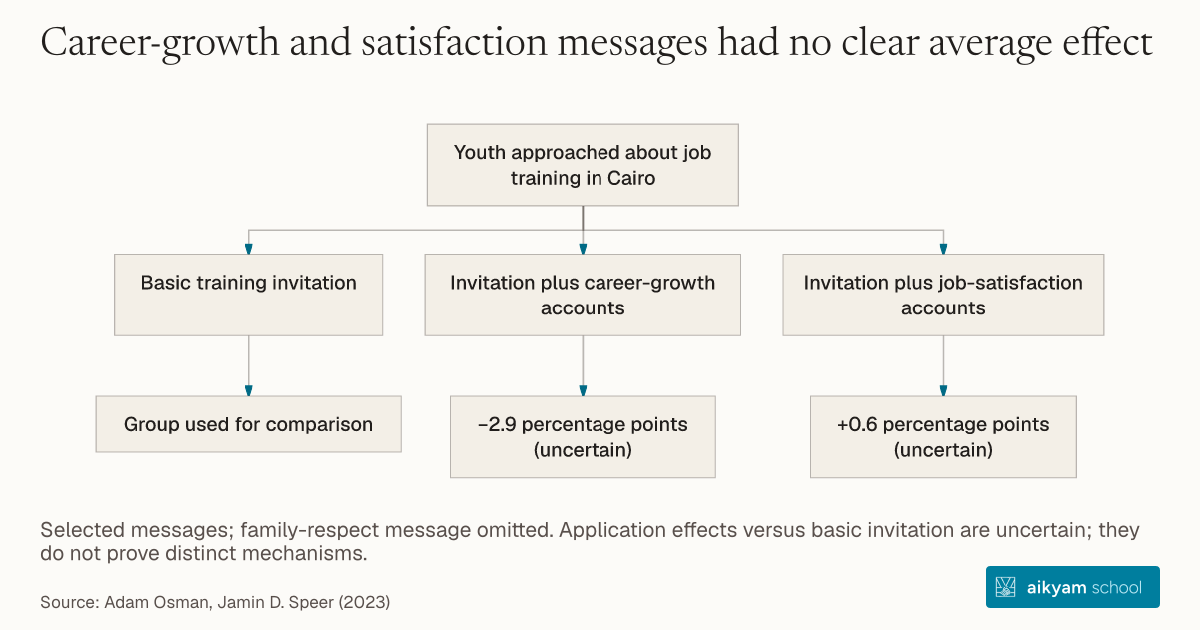
Youth approached about job training in Cairo
- Basic training invitation
- Group used for comparison
- Invitation plus career-growth accounts
- −2.9 percentage points (uncertain)
- Invitation plus job-satisfaction accounts
- +0.6 percentage points (uncertain)
In Experiment 1, the professional-message average application effect was −2.9 percentage points and the personal-message effect was +0.6 percentage points, both statistically uncertain. The basic invitation is the common comparison. These selected average estimates do not establish separate psychological mechanisms or a significant difference between the two messages.
See source →Research question
Jobseekers evaluate entry-level positions across three distinct non-monetary psychological dimensions: social judgment from family/peers, professional dead-end perceptions from future employers, and personal disappointment in job satisfaction. Targeting one dimension does not automatically resolve concerns along the other dimensions.
Participants
N = 1,470 youth for professional stigma, N = 1,460 for social stigma, and N = 1,464 for personal stigma; unemployed and underemployed youth aged 18–35 in Greater Cairo, Egypt (Experiment 1).
Study Design
Randomized Field Experiment testing street-level marketing pitches featuring past graduate testimonials tailored separately to professional advancement, social respect, and personal job satisfaction.
Results
Professional stigma messages decreased application rates by 2.9 percentage points on average (-0.125 percentage points for the bottom Machine Learning group, p = 0.015), while personal stigma messages showed virtually zero effect (+0.006 average, +0.047 bottom group, p = 0.756), proving these stigma dimensions operate through distinct psychological mechanisms.
Takeaway
Audit job recruitment materials to ensure career mobility messaging directly addresses long-term professional advancement rather than relying solely on personal satisfaction claims.
Source and citation
See source →Read alongside the research
Plain-English glossary
Original explanations, informed by the references below. Examples are illustrations, not data from the studies above. The research text stays unchanged.
- Percentage points
The difference between two percentages.
ExampleA rise from 40% to 50% is 10 percentage points. Relative to the starting value, that is a 25% increase.
Office for National Statistics · Percentages ↗Read more about percentage points →