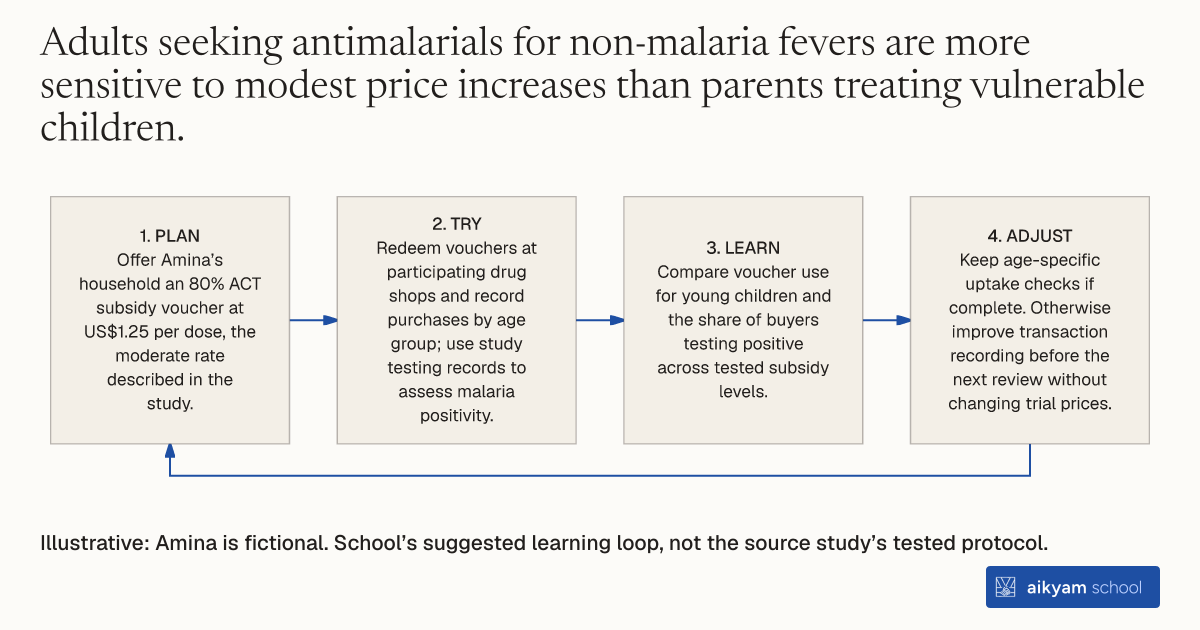
Try, learn and adjust
Check moderate subsidies preserve child access
- Plan: Offer Amina’s household an 80% ACT subsidy voucher at US$1.25 per dose, the moderate rate described in the study.
- Try: Redeem vouchers at participating drug shops and record purchases by age group; use study testing records to assess malaria positivity.
- Learn: Compare voucher use for young children and the share of buyers testing positive across tested subsidy levels.
- Adjust: Keep age-specific uptake checks if complete. Otherwise improve transaction recording before the next review without changing trial prices.
Illustrative: Amina is fictional. School’s suggested learning loop, not the source study’s tested protocol.
See source →School’s suggested, untested loop: observe child voucher use and malaria positivity. The study compared 80%, 88% and 92% subsidies; this is not prescribing advice.
How
When to use
High retail antimalarial subsidies successfully increase drug access for poor families but lead to widespread overtreatment among adults who self-diagnose without testing. Only 25 percent of adults purchasing heavily subsidized drugs actually test positive for malaria parasites. Calibrating the retail subsidy level to 80 percent curbs unnecessary adult usage while preserving full access for sick children.
Adjust retail drug price subsidies to a moderate discount rate that discourages unconfirmed adult purchases while maintaining pediatric access.
- Health managers set an intermediate retail drug subsidy level of 80 percent rather than 92 percent, pricing artemisinin combination therapy at US\$1.25 per dose.
- Field staff distribute price-discount vouchers at this calibrated rate to target households near local drug shops.
- Participating drug shops sell subsidized medications at the calibrated price to patients seeking treatment for malaria-like symptoms.
- Stationed staff record voucher redemption rates by age group to confirm that child treatment remains high while unconfirmed adult purchases fall.
Why it works
A slightly lower subsidy raises out-of-pocket costs enough to deter adults with unconfirmed fevers while keeping medication fully affordable for sick children.
Example
In western Kenya between May and December 2009, researchers tested three ACT subsidy levels (92 percent at US\$0.50, 88 percent at US\$0.75, and 80 percent at US\$1.25) across 2,789 households. Reducing the subsidy from 92 percent to 80 percent increased the share of ACT buyers who tested positive for malaria from 56 percent to 75 percent. Crucially, voucher use for young children remained completely unchanged across subsidy levels.
About the study
Participants
2,789 households living near four rural drug shops in a malaria-endemic region of western Kenya, with 38 percent of household heads illiterate.
Study Design
Randomized controlled trial conducted from May to December 2009 comparing an unsubsidized comparison group (US\$6.25) against three retail ACT subsidy levels: 92 percent (US\$0.50), 88 percent (US\$0.75), and 80 percent (US\$1.25). Post-purchase blood testing on a random sub-sample of buyers assessed malaria positivity rates across age brackets and subsidy tiers.
Results
Reducing the ACT subsidy level from 92 percent to 80 percent increased the proportion of ACT takers testing positive for malaria from 56 percent to 75 percent. Among adult buyers (ages 18+), only 25 percent tested positive under high subsidies, whereas 82 percent of children tested positive; reducing the subsidy deterred unconfirmed adult usage without decreasing coverage for sick children.