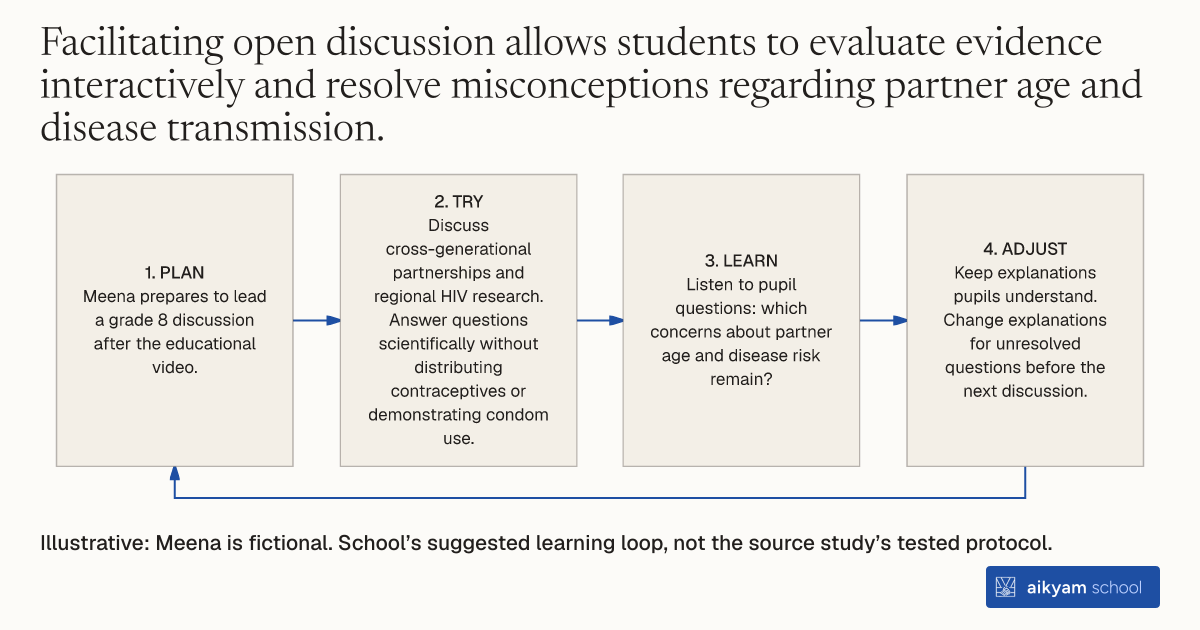
Try, learn and adjust
Check questions raised in the classroom discussion
- Plan: Meena prepares to lead a grade 8 discussion after the educational video.
- Try: Discuss cross-generational partnerships and regional HIV research. Answer questions scientifically without distributing contraceptives or demonstrating condom use.
- Learn: Listen to pupil questions: which concerns about partner age and disease risk remain?
- Adjust: Keep explanations pupils understand. Change explanations for unresolved questions before the next discussion.
Illustrative: Meena is fictional. School’s suggested learning loop, not the source study’s tested protocol.
See source →Observe pupil questions and unresolved misconceptions. School suggests this learning loop; discussion alone was not separately tested.
How
When to use
Primary students often view adult partners ("sugar daddies") through a lens of financial opportunity without discussing the underlying disease risks or social dynamics. Direct lecturing alone does not allow pupils to process complex social pressures or ask sensitive questions about partner safety. A guided open discussion led by a facilitator gives eighth-grade students a structured space to examine cross-generational sex risks and clarify health concerns.
Lead a structured open classroom discussion following an educational video to help upper-primary pupils analyze cross-generational sex dynamics and ask health questions.
- NGO facilitators transition from an educational video screening to leading a guided open classroom discussion with grade 8 pupils.
- Facilitators share regional research findings from Kenya, Zambia, and Zimbabwe detailing how cross-generational partnerships drive youth HIV transmission.
- Facilitators invite students to share observations and reflect on local social pressures, financial gifts, and sugar daddy relationships.
- Officers facilitate dialogue on partner selection trade-offs, contrasting the higher disease risks of adult men with the lower risks of teenage peers.
- Project officers answer student inquiries scientifically, including questions regarding condom protection, without distributing contraceptives or demonstrating condom use.
Why it works
Addressing sensitive student questions scientifically builds trust and helps youth internalize relative risk information when selecting sexual partners.
Example
In 71 primary schools in Western Kenya, NGO project officers conducted guided open discussions on cross-generational sex with eighth-grade classrooms in 2004. Over the following year, the combined relative risk session reduced teenage pregnancies fathered by men over 5 years older by 61.7 percent.
About the study
Participants
71 treatment primary schools and 257 comparison primary schools in Western Kenya, covering grade 8 primary students with an average age of 15 years.
Study Design
A randomized controlled trial evaluated the guided open discussion as part of a 40-minute relative risk campaign, tracking 12-month childbearing rates and male partner age gaps.
Results
The campaign featuring guided open discussions reduced overall teenage pregnancy by 28 percent (1.5 percentage points off a 5.4 percent baseline) and reduced pregnancies with partners over 5 years older by 61.7 percent.