Try, learn and adjust
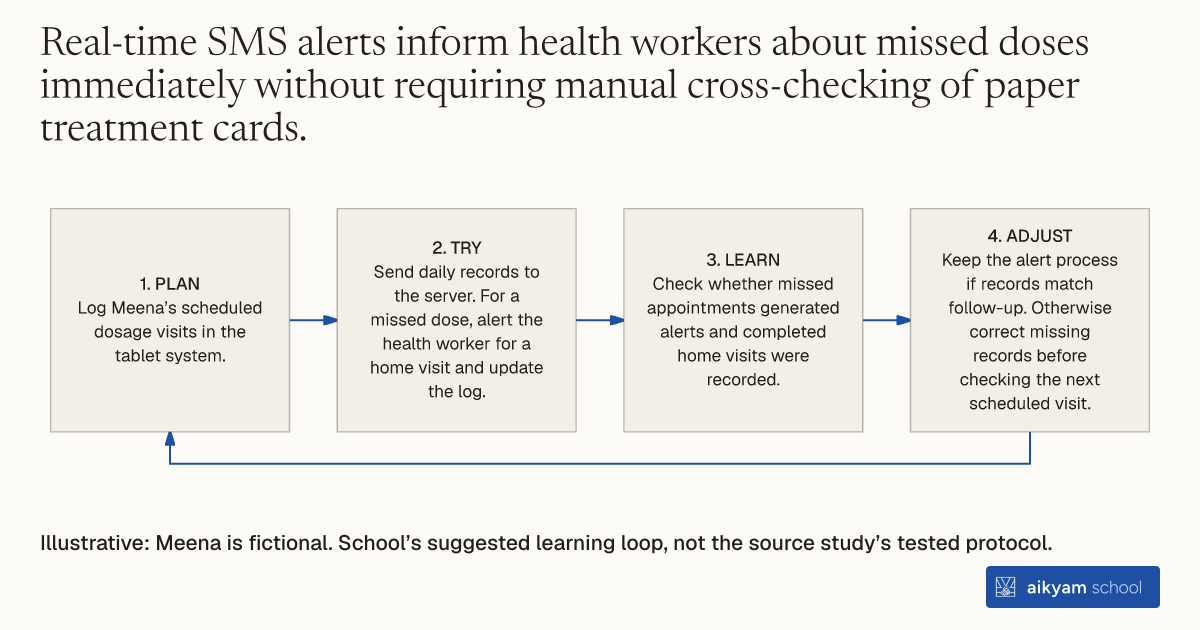
Check missed-dose alerts lead to follow-up
- Plan: Log Meena’s scheduled dosage visits in the tablet system.
- Try: Send daily records to the server. For a missed dose, alert the health worker for a home visit and update the log.
- Learn: Check whether missed appointments generated alerts and completed home visits were recorded.
- Adjust: Keep the alert process if records match follow-up. Otherwise correct missing records before checking the next scheduled visit.
Illustrative: Meena is fictional. School’s suggested learning loop, not the source study’s tested protocol.
See source →School’s suggested, untested loop: observe alerts, home visits and updated dose logs. Clinical treatment remains with health workers.
How
When to use
In decentralized healthcare delivery programs, tracking when patients miss scheduled medication doses is slow when relying on paper treatment logs. Health workers often discover missed appointments days or weeks later, delaying crucial follow-up visits. Automatically sending digital alerts when patients miss scheduled visits enables providers to intervene immediately before patients interrupt treatment.
Implement an automated server system that triggers SMS notifications to health workers whenever a patient fails to check in for a scheduled medication dose.
- Health workers log patient visits daily into a tablet connected to a central server.
- The server compares daily log-in records against patient dosage schedules to identify missed appointments.
- The server automatically sends an SMS alert to the responsible health worker's mobile device when a dose is missed.
- Health workers receive the notification and conduct a home visit to deliver medication and prevent treatment default.
- The server updates the central patient log once the follow-up visit and dose intake are completed.
Why it works
Rapid notifications prompt timely home visits to re-engage patients before treatment interruption becomes chronic.
Example
Operation ASHA integrated SMS missed-dose alerts into 34 tuberculosis centers in urban India, increasing health worker home visits for missed doses by 32 percent compared to 31 unmonitored centers.
About the study
Participants
65 OpASHA catchment areas serving urban informal settlements across four states in Northern India, each serving nearly 40,000 individuals and managed by one health worker.
Study Design
Randomized controlled trial across 65 catchment areas (34 treatment and 31 control), collecting data from patient surveys, official health registers, provider interviews, random clinic spot checks, and day-long clinic observations over 12 to 14 months.
Results
Automated SMS alerts and biometric tracking increased the frequency of health worker home visits to patients missing dosages by 32 percent (4 percentage points), reduced treatment default by 1.8 percentage points (25 percent) from 7.3 percent to 5.5 percent, and halved health worker concerns of excessive workload by 10.5 percentage points.