Try, learn and adjust
Check daily logs produce missed-dose alerts
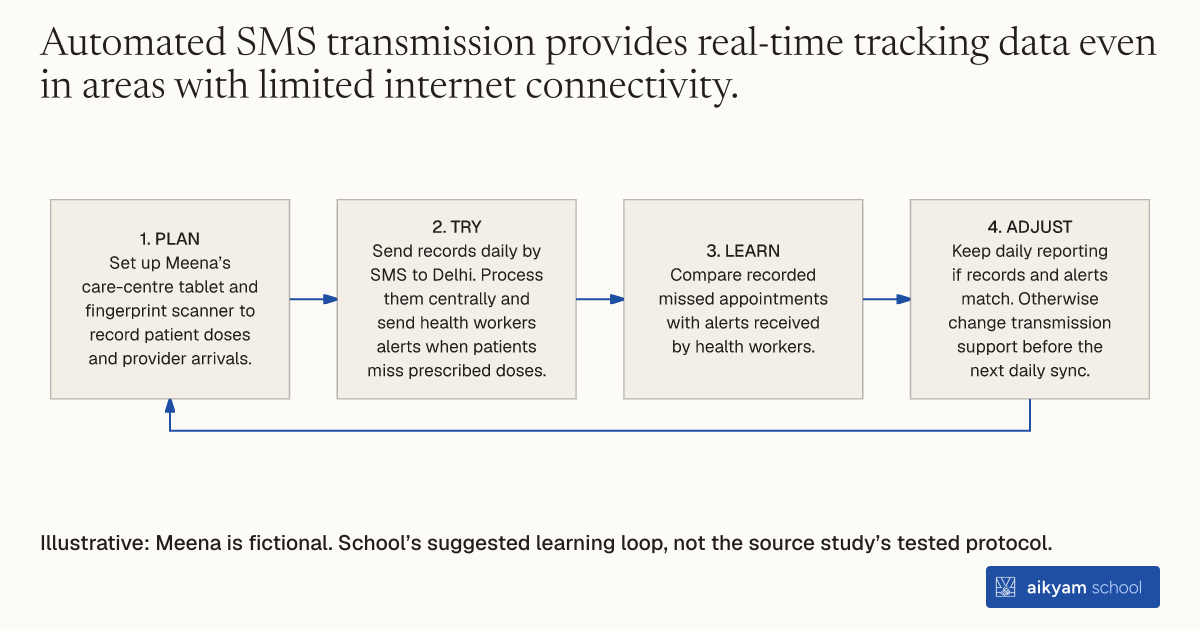
- Plan: Set up Meena’s care-centre tablet and fingerprint scanner to record patient doses and provider arrivals.
- Try: Send records daily by SMS to Delhi. Process them centrally and send health workers alerts when patients miss prescribed doses.
- Learn: Compare recorded missed appointments with alerts received by health workers.
- Adjust: Keep daily reporting if records and alerts match. Otherwise change transmission support before the next daily sync.
Illustrative: Meena is fictional. School’s suggested learning loop, not the source study’s tested protocol.
See source →School’s suggested learning loop: observe daily transmissions and missed-dose alerts; this check is not a clinical protocol or proof of adherence.
How
When to use
Paper-based record keeping in primary health centers is slow, error-prone, and prone to misreporting by health workers. Central management cannot track treatment interruptions or missing doses in real time across remote centers. Transmitting daily biometric logging data via automated SMS messages alerts health workers immediately when patients miss medication.
Automate daily data sync and SMS alerts between care center biometric terminals and central servers to track treatment adherence.
- Connect a tablet and fingerprint scanner terminal at the local health care center.
- Record each patient dose and provider arrival time locally on the biometric terminal.
- Transmit logged attendance and dose data daily via SMS to the central server in Delhi.
- Process daily records automatically on the central server to flag missed patient appointments.
- Send automated SMS alerts and reminders to health workers when a patient fails to take a prescribed dose.
Why it works
Centralized automated alerts prompt health workers to perform immediate follow-ups before treatment interruptions lead to complete patient default.
Example
Operation ASHA implemented eCompliance daily SMS data syncing across 34 treatment centers in India, enabling central monitoring in Delhi and generating automated missed-dose alerts for health workers.
About the study
Participants
141 healthcare workers across 65 catchment areas in Madhya Pradesh, Punjab, Delhi, Uttar Pradesh, Chhattisgarh, and Orissa (Bhubaneshwar), India.
Study Design
Randomized controlled trial assigning 34 catchment areas to eCompliance SMS tracking and 31 catchment areas to a paper-based comparison group over a 12 to 14 month evaluation period.
Results
Automated logging and alerts reduced underreporting of treatment interruptions by 25 percent, reduced overreporting of new cases by 20 percent, and increased home visits for missed doses by 32 percent (about 4 percentage points).