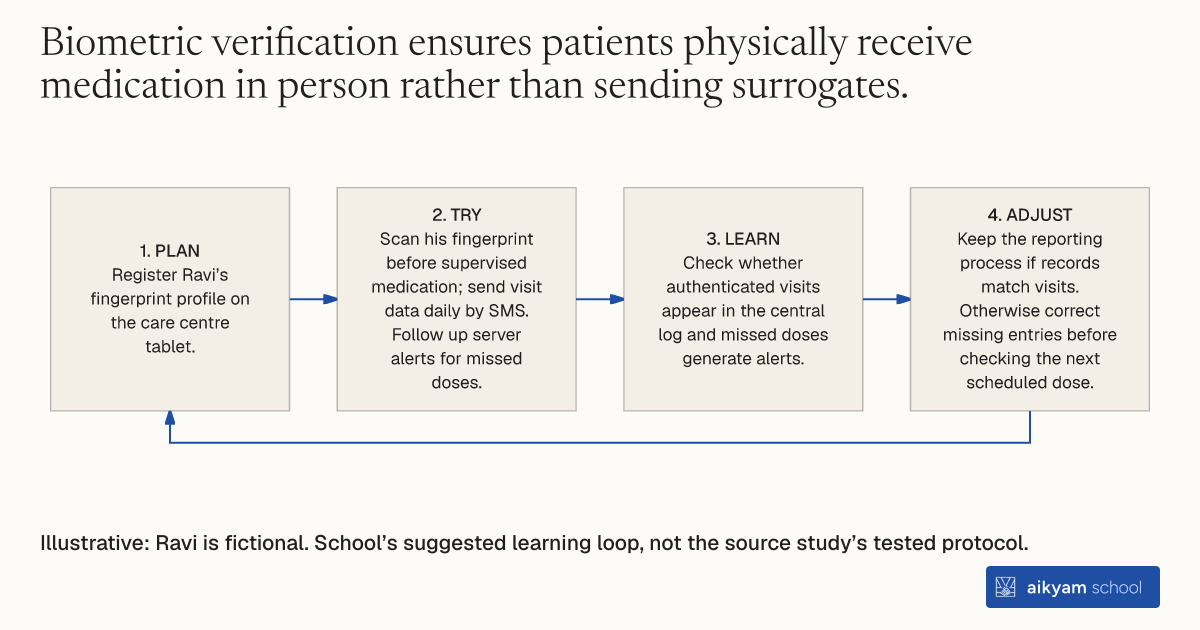
Try, learn and adjust
Check fingerprint visits reach the dose log
- Plan: Register Ravi’s fingerprint profile on the care centre tablet.
- Try: Scan his fingerprint before supervised medication; send visit data daily by SMS. Follow up server alerts for missed doses.
- Learn: Check whether authenticated visits appear in the central log and missed doses generate alerts.
- Adjust: Keep the reporting process if records match visits. Otherwise correct missing entries before checking the next scheduled dose.
Illustrative: Ravi is fictional. School’s suggested learning loop, not the source study’s tested protocol.
See source →School’s suggested, untested loop: observe authenticated visits, dose records and alerts. This loop does not alter prescribed treatment.
How
When to use
In resource-limited settings delivering Directly Observed Therapy for tuberculosis, paper records make tracking dose intake time-consuming and error-prone. Patients frequently send representatives to collect medication or interrupt treatment altogether. Biometric verification requires digital fingerprint scans at each dose delivery to ensure patients receive treatment in person.
Require patients to register and scan fingerprints at care centers whenever taking prescribed medication under health worker supervision.
- Health workers register each patient's biometric profile into a tablet attached to a fingerprint scanner during enrollment.
- Patients visit the care center for each required medication dose.
- Health workers scan the patient's fingerprint on the scanner before dispensing medication.
- The tablet logs the authenticated visit and transmits dose data daily via SMS to a central server.
- The server generates automated alerts when a patient misses a scheduled dose so health workers can follow up.
Why it works
Automated tracking prompts health workers to follow up quickly on missed doses and reduces recordkeeping workload.
Example
Operation ASHA installed biometric devices across 34 tuberculosis centers in four Indian states, increasing in-person medication consumption by 26 percent and reducing treatment defaults by 25 percent compared to 31 comparison centers.
About the study
Participants
65 catchment areas serving urban informal settlements across four states in Northern India, each serving nearly 40,000 individuals and managed by one health worker.
Study Design
Randomized controlled trial across 65 catchment areas (34 treatment and 31 control), collecting patient surveys, administrative records, provider interviews, random clinic visits, and day-long observations over 12 to 14 months.
Results
Biometric tracking increased in-person pill intake by 13.9 percentage points (26 percent) from 54 percent to 68 percent, decreased treatment default by 1.8 percentage points (25 percent) from 7.3 percent to 5.5 percent, and reduced sending a surrogate for medication by 21.8 percentage points (60 percent).