Research steps
Compare total effects with direct effects
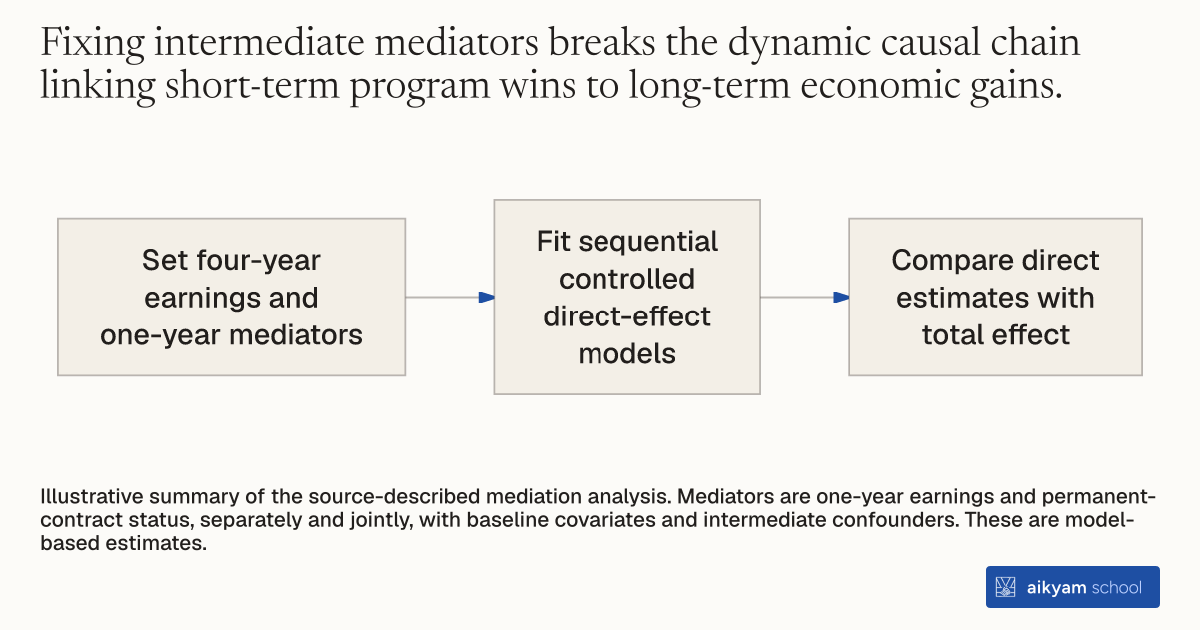
- Set four-year earnings and one-year mediators
- Fit sequential controlled direct-effect models
- Compare direct estimates with total effect
Illustrative summary of the source-described mediation analysis. Mediators are one-year earnings and permanent-contract status, separately and jointly, with baseline covariates and intermediate confounders. These are model-based estimates.
See source →How
When to use
Researchers need to decompose long-run intervention impacts into intermediate mechanisms without post-treatment selection bias. Standard linear regression controls for intermediate variables introduce collider bias. Compute sequential Average Controlled Direct Effects to isolate how specific short-run employment mediators drive multi-year earnings growth.
Estimate Sequential Average Controlled Direct Effects to quantify the proportion of long-run treatment impacts explained by intermediate short-run mechanisms.
- Define primary long-run outcome variables, such as 4-year wage earnings, alongside short-run candidate mediators measured at earlier endlines.
- Select short-run mediating variables, specifically 1-year monthly earnings and formal permanent contract status.
- Fix each mediator to specific counterfactual levels across experimental groups following the causal inference framework of Acharya, Blackwell, and Sen (2016).
- Estimate sequential Average Controlled Direct Effect models controlling for baseline covariates and intermediate post-treatment confounders to eliminate selection bias.
- Compare the unadjusted total treatment effect to the estimated direct effect coefficients to calculate the exact percentage of long-run earnings accounted for by each mediator.
Why it works
Comparing direct effect estimates to the total treatment effect reveals whether long-run success relies on early formal job placement rather than temporary work experience.
Example
Researchers evaluated 4-year monthly earnings mechanisms for young job-seekers in Addis Ababa, Ethiopia. Direct effect estimates demonstrated that 1-year earnings accounted for 56% of the 4-year workshop earnings effect, 1-year permanent work accounted for 23%, and fixing both mediators jointly accounted for 62% of long-term gains.
About the study
Participants
N = 3,052 young job-seekers aged 18–29 in Addis Ababa, Ethiopia evaluated across 8-month and 4-year follow-up rounds.
Study Design
Causal mediation analysis calculating Average Controlled Direct Effects according to Acharya et al. (2016) methodology.
Results
Short-run earnings accounted for 56% of the long-run workshop earnings impact, short-run permanent contract status accounted for 23%, and combined short-run earnings and permanent status accounted for 62% of the total 4-year treatment effect.