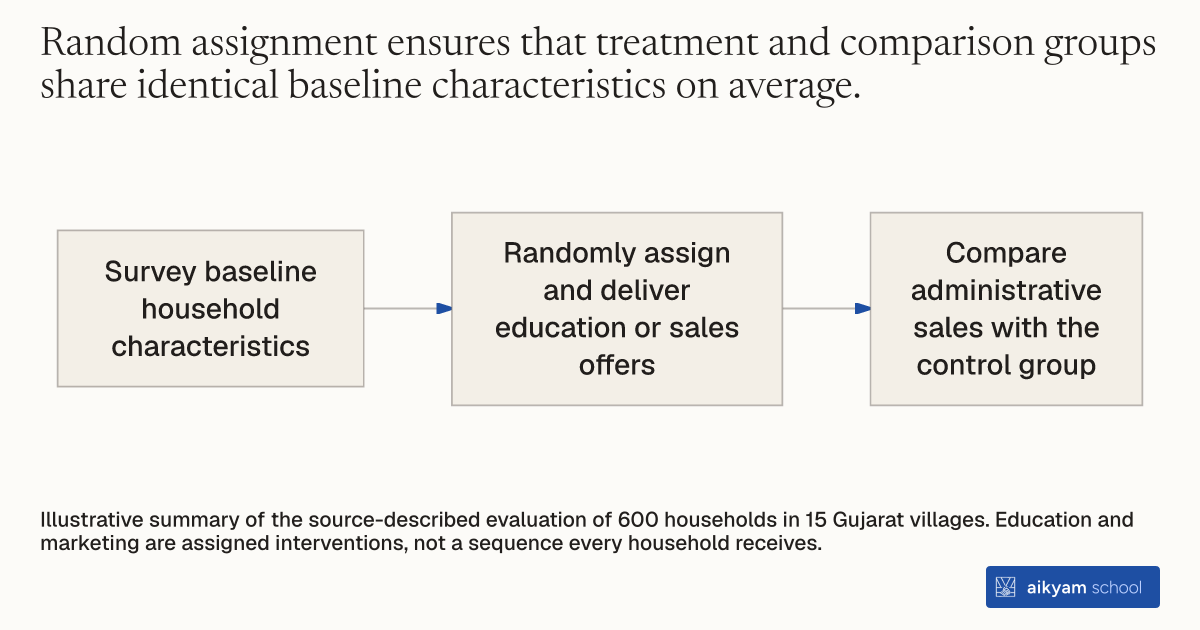
Research steps
Evaluate insurance adoption strategies
- Survey baseline household characteristics
- Randomly assign and deliver education or sales offers
- Compare administrative sales with the control group
Illustrative summary of the source-described evaluation of 600 households in 15 Gujarat villages. Education and marketing are assigned interventions, not a sequence every household receives.
See source →How
When to use
Organizations introducing novel microfinance products need robust empirical evidence to evaluate which marketing or educational strategies genuinely drive adoption. Conducting a randomized controlled trial allows program evaluators to isolate the causal impacts of specific interventions from background market noise. This method applies to development agencies testing behavioral innovations across rural target populations.
Execute a randomized controlled trial comparing multiple intervention arms against a control group to evaluate product demand drivers.
- Define the study population and establish baseline characteristics through household surveys across project villages.
- Randomly assign eligible households to treatment groups receiving specific educational or marketing interventions, alongside a comparison control group.
- Deliver assigned treatments, such as financial literacy sessions or specialized door-to-door sales offers, to designated treatment groups.
- Measure administrative sales data across all groups after intervention delivery to estimate treatment effect sizes relative to the comparison control group.
Why it works
Comparing take-up rates isolates the true causal impact of each intervention strategy.
Example
Researchers evaluated rainfall insurance uptake among six hundred smallholder farmers in coastal Gujarat, India, randomly assigning households to financial literacy programs and door-to-door marketing offers while maintaining a comparison group.
About the study
Participants
600 landowning cotton and groundnut farming households across 15 coastal villages in Gujarat, India.
Study Design
Cluster-randomized evaluation assigning households to financial education workshops and door-to-door sales messages (forecasts, demonstrations, money-back guarantees) alongside comparison controls.
Results
The RCT established that financial literacy invitations increased insurance take-up by 5.3 percentage points and money-back guarantees increased take-up by 6.9 percentage points above the 6.4 percent control baseline.