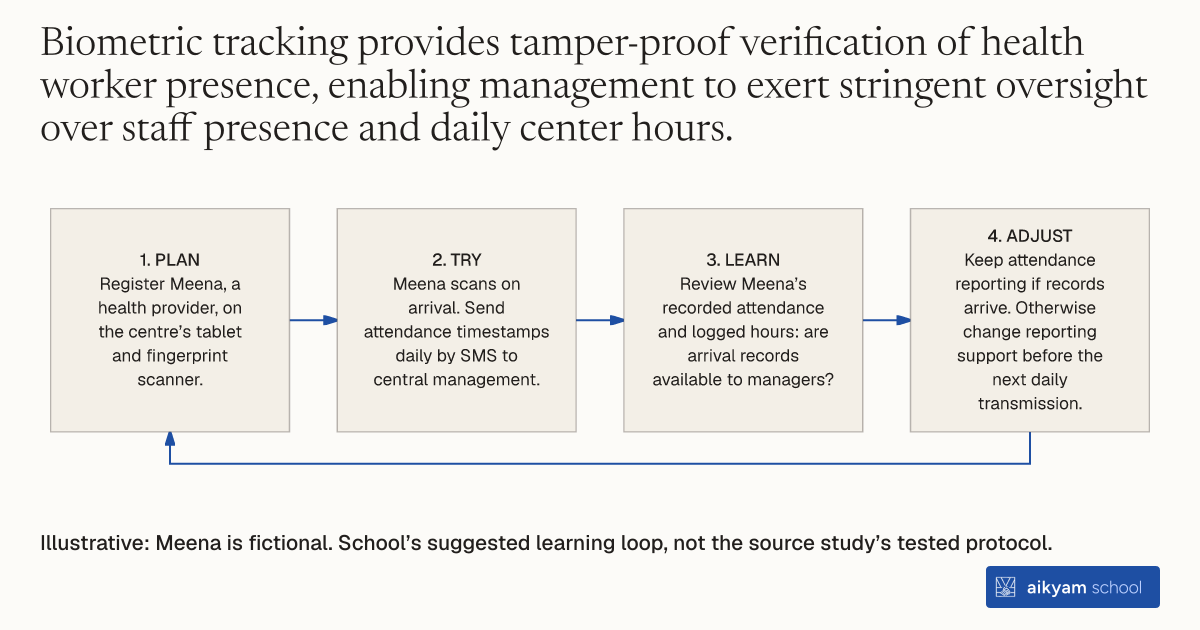
Try, learn and adjust
Check provider arrivals reach management records
- Plan: Register Meena, a health provider, on the centre’s tablet and fingerprint scanner.
- Try: Meena scans on arrival. Send attendance timestamps daily by SMS to central management.
- Learn: Review Meena’s recorded attendance and logged hours: are arrival records available to managers?
- Adjust: Keep attendance reporting if records arrive. Otherwise change reporting support before the next daily transmission.
Illustrative: Meena is fictional. School’s suggested learning loop, not the source study’s tested protocol.
See source →School’s suggested learning loop: observe attendance timestamps, logged hours and reporting; records alone do not establish better patient outcomes.
How
When to use
Healthcare provider absenteeism and low effort undermine treatment delivery in decentralized public health systems. Paper registers allow providers to fake arrival times or logged hours without management oversight. Biometric tracking solves this by requiring health workers to verify their attendance via fingerprint scans whenever they arrive at treatment centers.
Require health workers to scan their fingerprint on a digital tracking device upon arrival at healthcare facilities.
- Mount a tablet paired with a fingerprint scanner at the primary care center.
- Register the biometric fingerprint data of assigned health providers in the central system.
- Require health workers to scan their fingerprint each time they arrive at the center.
- Transmit attendance timestamps automatically via daily SMS to central management.
- Review provider attendance and hours logged to enforce management oversight.
Example
Operation ASHA introduced eCompliance biometric attendance tracking for 141 healthcare workers across primary care centers in six states in India, increasing provider attendance and home visits.
About the study
Participants
141 healthcare workers across 65 catchment areas in Madhya Pradesh, Punjab, Delhi, Uttar Pradesh, Chhattisgarh, and Orissa (Bhubaneshwar), India.
Study Design
Randomized controlled trial assigning 34 catchment areas to biometric tracking and 31 catchment areas to a comparison group over a 12 to 14 month evaluation period.
Results
Provider attendance increased by up to 12 percent (about 7 percentage points), time spent at centers increased by 19 percent (about 22 minutes per day), and home visits for missed doses increased by 32 percent (about 4 percentage points).