Try, learn and adjust
Check fingerprint verification and dose-event records
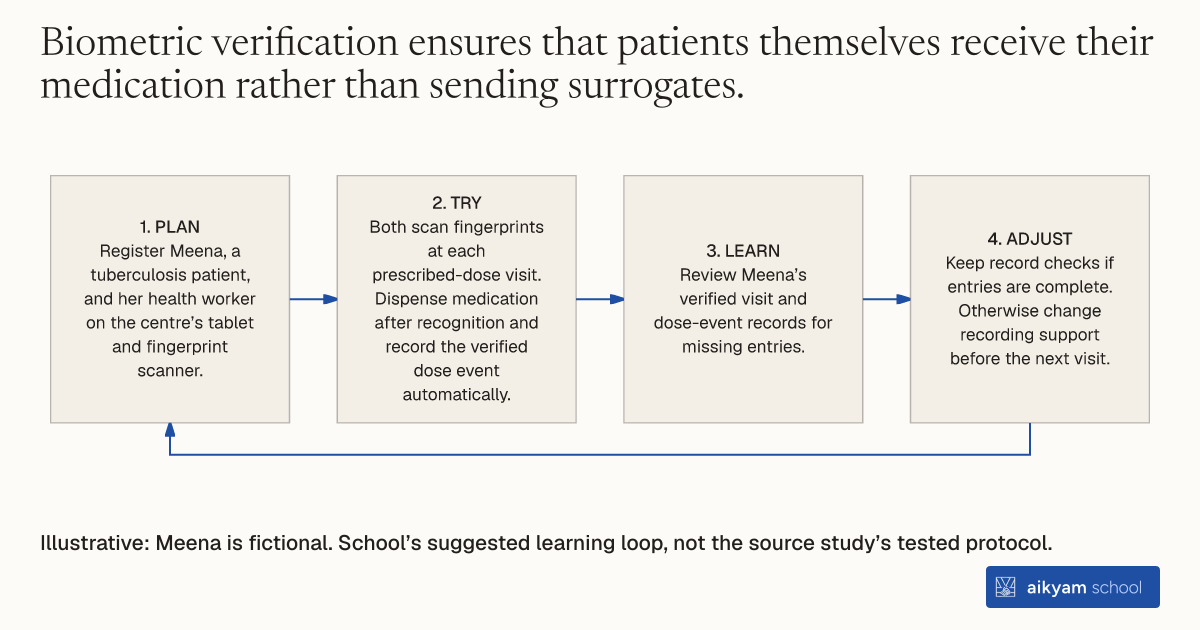
- Plan: Register Meena, a tuberculosis patient, and her health worker on the centre’s tablet and fingerprint scanner.
- Try: Both scan fingerprints at each prescribed-dose visit. Dispense medication after recognition and record the verified dose event automatically.
- Learn: Review Meena’s verified visit and dose-event records for missing entries.
- Adjust: Keep record checks if entries are complete. Otherwise change recording support before the next visit.
Illustrative: Meena is fictional. School’s suggested learning loop, not the source study’s tested protocol.
See source →School’s suggested learning loop: observe identity verification and recorded dose events; it is not a clinical treatment protocol or proof of swallowing.
How
When to use
Tuberculosis treatment requires consuming multiple drugs over a six-month period, which often leads to poor adherence due to strong side effects and stigma. Paper-based tracking systems in primary care centers fail to accurately record whether patients swallow their medication. Biometric tracking solves this by requiring fingerprint identification at care centers for patients undergoing treatment.
Require patients and health workers to verify their identity on a biometric device before dispensing medication at local care centers.
- Mount a digital tablet attached to a fingerprint scanner at the care center.
- Register the fingerprint of each tuberculosis patient and health worker into the eCompliance system.
- Prompt the patient and health worker to scan their fingerprints on arrival at the center for each prescribed dose.
- Dispense the required antibiotic medication directly to the patient after successful fingerprint recognition.
- Record every verified dose event automatically in the system database.
Why it works
It also prevents healthcare workers from misreporting pill administration or overreporting patient cases.
Example
Operation ASHA deployed eCompliance biometric devices across 34 catchment areas in India serving tuberculosis patients, reducing treatment default rates from 7.3 percent to 1.8 percentage points.
About the study
Participants
141 healthcare workers across 65 catchment areas in Madhya Pradesh, Punjab, Delhi, Uttar Pradesh, Chhattisgarh, and Orissa (Bhubaneshwar), India.
Study Design
Randomized controlled trial assigning 34 catchment areas to receive biometric devices and 31 catchment areas to a comparison group over a 12 to 14 month evaluation period.
Results
Patients in biometric tracking centers were 1.8 percentage points (25 percent) less likely to default compared to 7.3 percent in the comparison group, in-person pill intake increased by 13.9 percentage points (26 percent), and patients were 21.8 percentage points (60 percent) less likely to send surrogates.