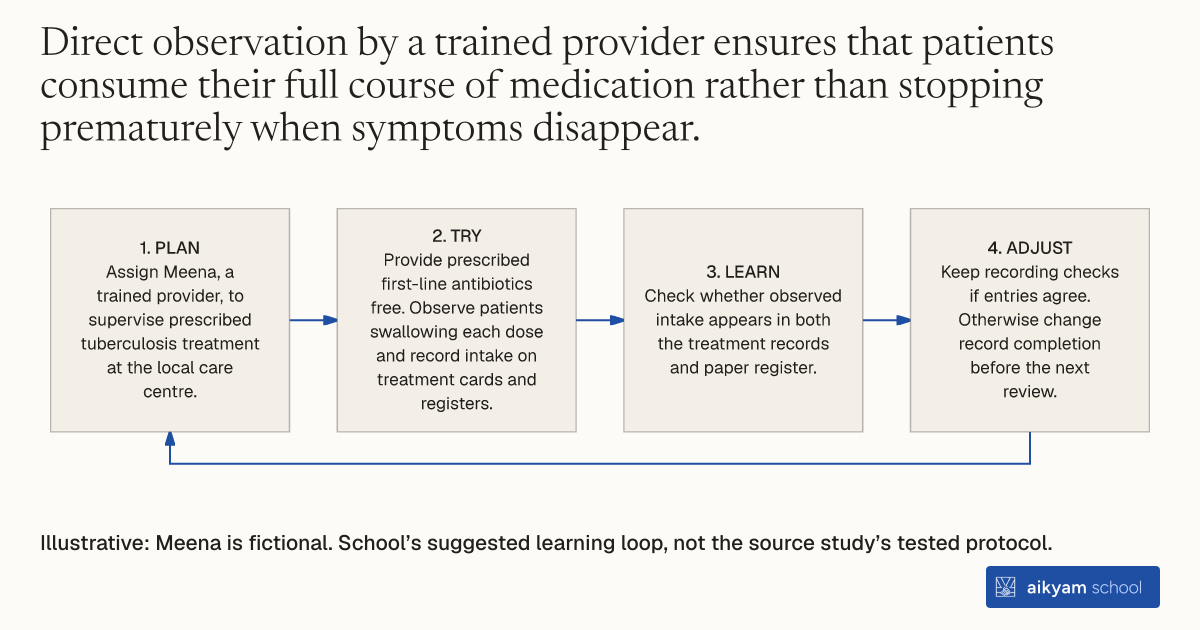
Try, learn and adjust
Check observed medication intake is recorded
- Plan: Assign Meena, a trained provider, to supervise prescribed tuberculosis treatment at the local care centre.
- Try: Provide prescribed first-line antibiotics free. Observe patients swallowing each dose and record intake on treatment cards and registers.
- Learn: Check whether observed intake appears in both the treatment records and paper register.
- Adjust: Keep recording checks if entries agree. Otherwise change record completion before the next review.
Illustrative: Meena is fictional. School’s suggested learning loop, not the source study’s tested protocol.
See source →School’s suggested learning loop: observe documentation of supervised intake; this is a record check, not a replacement clinical protocol.
How
When to use
Stopping the spread of tuberculosis requires detecting infection early and ensuring patients complete a six-month course of treatment. Adherence is difficult because patients must take multiple antibiotics simultaneously over a long duration despite side effects. The Directly Observed Therapy, Short Course protocol solves this by requiring trained providers to supervise patients swallowing every medication dose in person.
Administer tuberculosis antibiotics through supervised in-person intake at local care centers following World Health Organization guidelines.
- Assign a trained health provider to manage a care center serving a catchment area of nearly 40,000 individuals.
- Detect active tuberculosis cases early among community members in the catchment area.
- Dispense prescribed first-line antibiotic medications directly to diagnosed patients at no cost.
- Observe the patient directly as they ingest each prescribed treatment dose at the local center.
- Record patient medication intake on official treatment cards and paper registers.
Why it works
Free access to first-line antibiotics removes financial barriers to completing treatment.
Example
The Government of India and Operation ASHA implemented DOTS across catchment areas in India, providing direct observation and free first-line antibiotics to tuberculosis patients across multiple states.
About the study
Participants
141 healthcare workers across 65 catchment areas in Madhya Pradesh, Punjab, Delhi, Uttar Pradesh, Chhattisgarh, and Orissa (Bhubaneshwar), India.
Study Design
Randomized controlled trial across 65 catchment areas comparing 34 biometric DOTS centers with 31 standard paper-based DOTS centers over a 12 to 14 month evaluation period.
Results
Standard DOTS centers without biometric tracking had a 7.3 percent default rate, while 97 percent of new tuberculosis cases were treatable with free first-line antibiotics.