Research steps
Build the household sampling frame
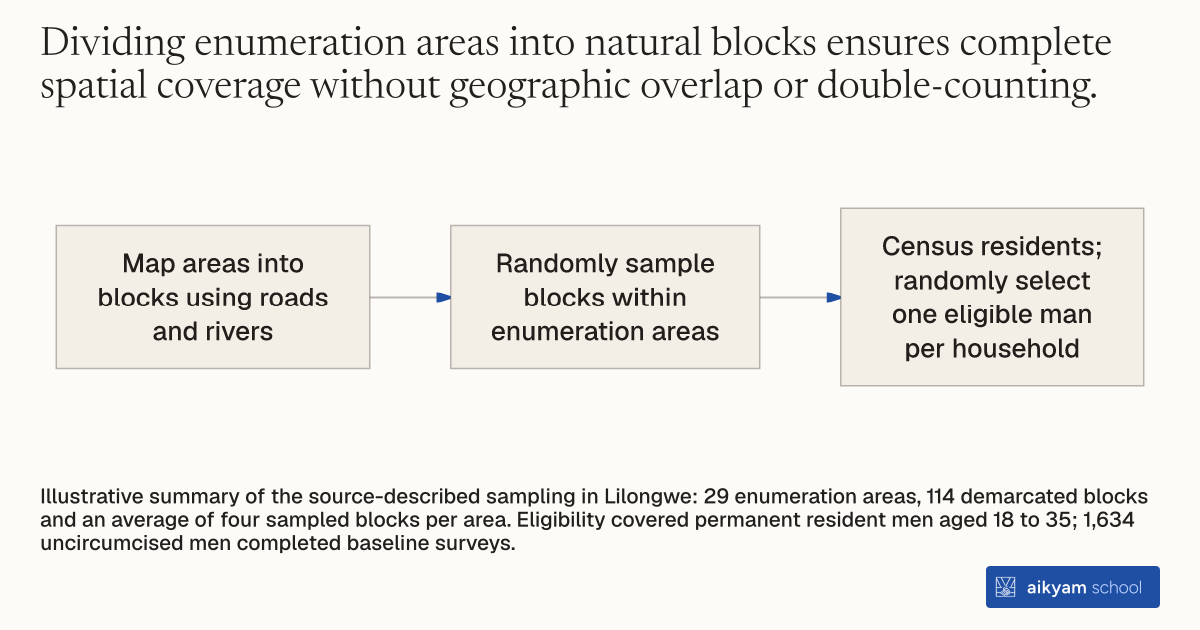
- Map areas into blocks using roads and rivers
- Randomly sample blocks within enumeration areas
- Census residents; randomly select one eligible man per household
Illustrative summary of the source-described sampling in Lilongwe: 29 enumeration areas, 114 demarcated blocks and an average of four sampled blocks per area. Eligibility covered permanent resident men aged 18 to 35; 1,634 uncircumcised men completed baseline surveys.
See source →How
When to use
In urban health interventions, researchers need a representative sample of eligible individuals in a clinic catchment area. Unstructured sampling can miss eligible residents or fail to establish an accurate denominator of potential service users. This method systematically identifies target individuals through localized spatial mapping and full household census listings.
Map a health clinic catchment area into distinct neighborhood blocks, conduct a complete household census to list target residents, and randomly select eligible individuals.
- Define the study area using National Statistics Office enumeration areas within the target clinic catchment area.
- Subdivide each enumeration area into neighborhood blocks using natural dividing lines such as roads and rivers.
- Randomly select neighborhood blocks into the study, stratified by enumeration area.
- Conduct a full household census within each selected block to identify permanent resident men aged 18 to 35.
- Randomly select one eligible man per household if multiple resident men qualify.
Why it works
Conducting a census within selected blocks provides an accurate sampling frame and precise denominator of target community members.
Example
Researchers mapped the catchment area of a private health clinic in Lilongwe, Malawi into 29 enumeration areas and subdivided them into 114 neighborhood blocks. They sampled an average of 4 blocks per enumeration area and identified 1,634 eligible uncircumcised men who completed baseline surveys.
About the study
Participants
1,634 uncircumcised men aged 18 to 35 residing in urban Lilongwe, Malawi.
Study Design
Stratified random block selection within 29 enumeration areas, followed by household census enumeration and individual random sampling per household.
Results
Identified and enrolled 1,634 eligible uncircumcised men from 114 demarcated neighborhood blocks across Lilongwe.