Research steps
Link clinic vouchers to survey participants
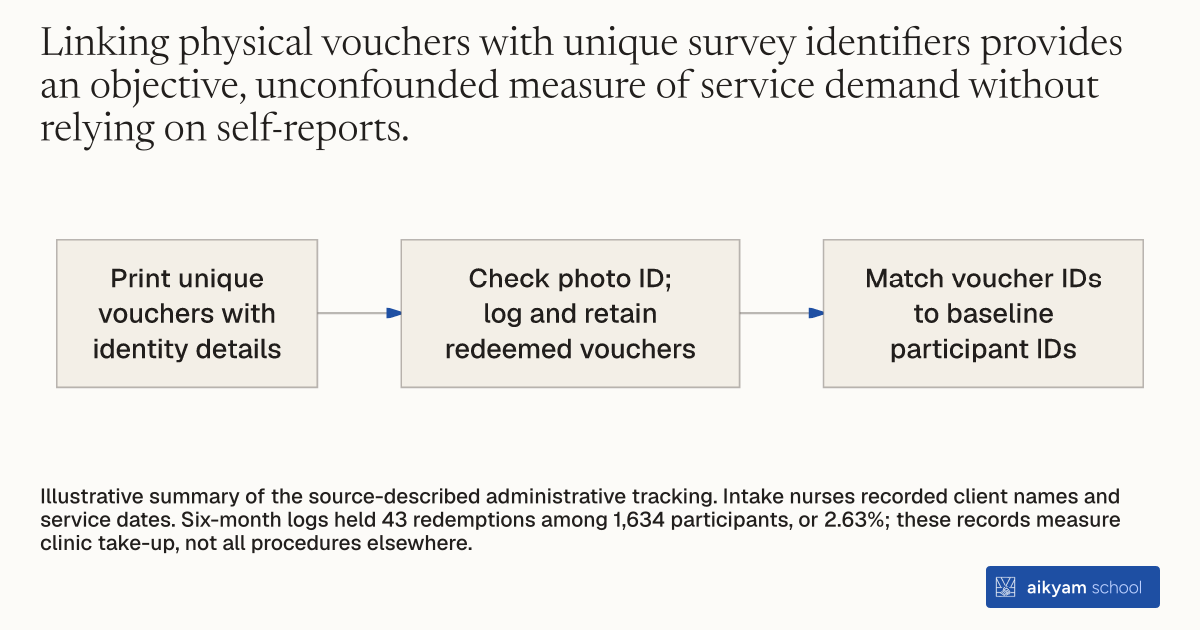
- Print unique vouchers with identity details
- Check photo ID; log and retain redeemed vouchers
- Match voucher IDs to baseline participant IDs
Illustrative summary of the source-described administrative tracking. Intake nurses recorded client names and service dates. Six-month logs held 43 redemptions among 1,634 participants, or 2.63%; these records measure clinic take-up, not all procedures elsewhere.
See source →How
When to use
In field experiments, self-reported health behaviors can be biased by social desirability or recall errors. Researchers need an objective administrative tracking system to verify actual service take-up. This method uses coded fee-subsidy vouchers collected by clinic intake staff to track individual service utilization.
Collect and link randomized vouchers at clinical intake to record exact service take-up during a multi-month intervention period.
- Print serialized vouchers containing a unique voucher ID, participant full name, and recorded government photo identification type.
- Require clients to present the voucher along with matching photo identification upon arriving at the clinic intake desk.
- Instruct intake nurses to record voucher redemptions, client names, and service dates in a dedicated clinical log.
- Keep the collected vouchers on file at the clinic to create a physical audit trail.
- Match redeemed voucher IDs back to baseline survey participant IDs to measure objective service adoption rates.
Why it works
Retaining collected vouchers at clinical intake creates an auditable administrative record that directly verifies price-specific redemption rates.
Example
At a partner health clinic in Lilongwe, Malawi, intake nurses collected and logged 43 serialized vouchers over a six-month period following a baseline survey of 1,634 men, verifying an objective circumcision take-up rate of 2.63 percent.
About the study
Participants
1,634 uncircumcised men aged 18 to 35 residing in urban Lilongwe, Malawi.
Study Design
Administrative voucher tracking conducted by clinical intake staff over six months to record voucher redemptions and verify participant identity.
Results
Clinical intake logs recorded 43 redeemed vouchers out of 1,634 study participants, establishing a verified medical circumcision take-up rate of 2.63 percent.