Try, learn and adjust
Check voluntary home testing and sample transfer
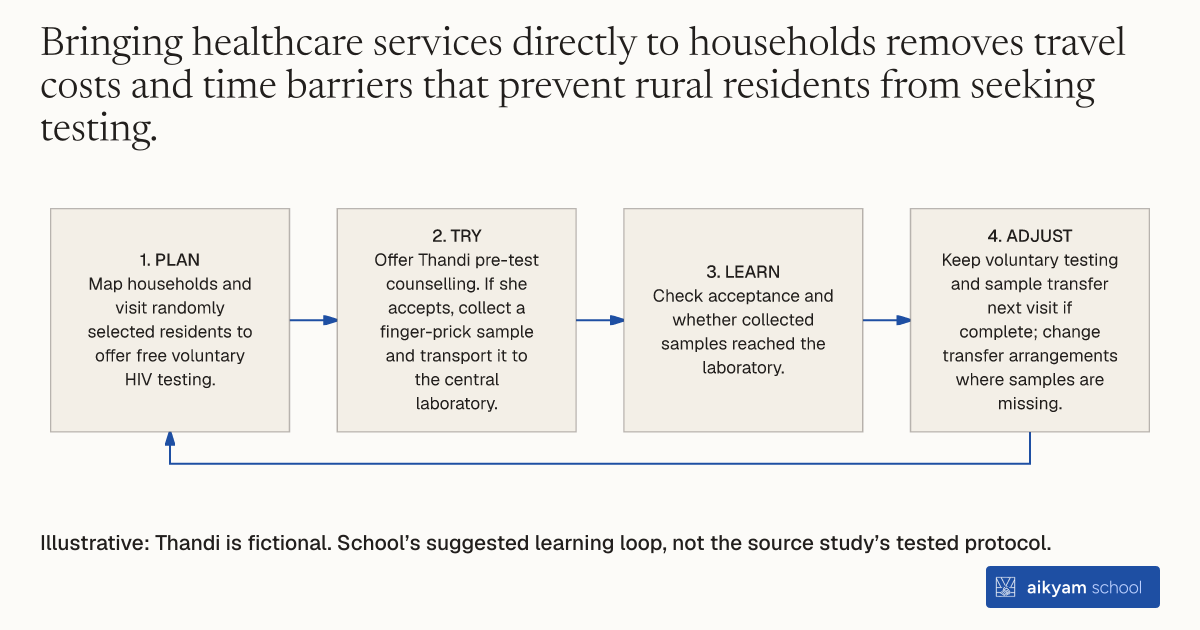
- Plan: Map households and visit randomly selected residents to offer free voluntary HIV testing.
- Try: Offer Thandi pre-test counselling. If she accepts, collect a finger-prick sample and transport it to the central laboratory.
- Learn: Check acceptance and whether collected samples reached the laboratory.
- Adjust: Keep voluntary testing and sample transfer next visit if complete; change transfer arrangements where samples are missing.
Illustrative: Thandi is fictional. School’s suggested learning loop, not the source study’s tested protocol.
See source →School’s suggested learning loop; not a tested source procedure. Observe acceptance and sample receipt. This is a learning aid, not a clinical testing protocol.
How
When to use
Many people in rural areas do not know their HIV status because health clinics are far away. Visiting individuals directly at their homes overcomes spatial and financial barriers to diagnostic testing. Door-to-door testing provides free access to health screening for entire rural populations.
Conduct door-to-door visits to offer free voluntary HIV testing and blood sample collection across rural communities.
- Map and list households across target rural villages.
- Visit randomly selected household residents directly in their homes.
- Offer free voluntary HIV testing and pre-test health counseling to eligible adults and adolescents.
- Collect blood samples from accepting individuals using finger-prick blood draws.
- Transport collected blood samples to a central laboratory for diagnostic processing.
Why it works
Offering free testing at home normalizes health screening and achieves high participation rates.
Example
Field staff visited households across 125 rural villages in three districts of Malawi in 2004 to offer free voluntary HIV testing. Among 3,185 residents offered a test at home, 91 percent accepted, allowing nurses to collect blood samples from 2,894 individuals.
About the study
Participants
3,185 rural Malawian adults and adolescents across 125 villages in three districts, with 2,894 individuals accepting testing.
Study Design
Population-based door-to-door voluntary HIV testing study embedded in a longitudinal panel survey across rural villages.
Results
Door-to-door home testing achieved a 91 percent acceptance rate among offered individuals, revealing a 6.4 percent HIV prevalence rate among tested respondents.