Research procedure
Calibrate a labour supply model
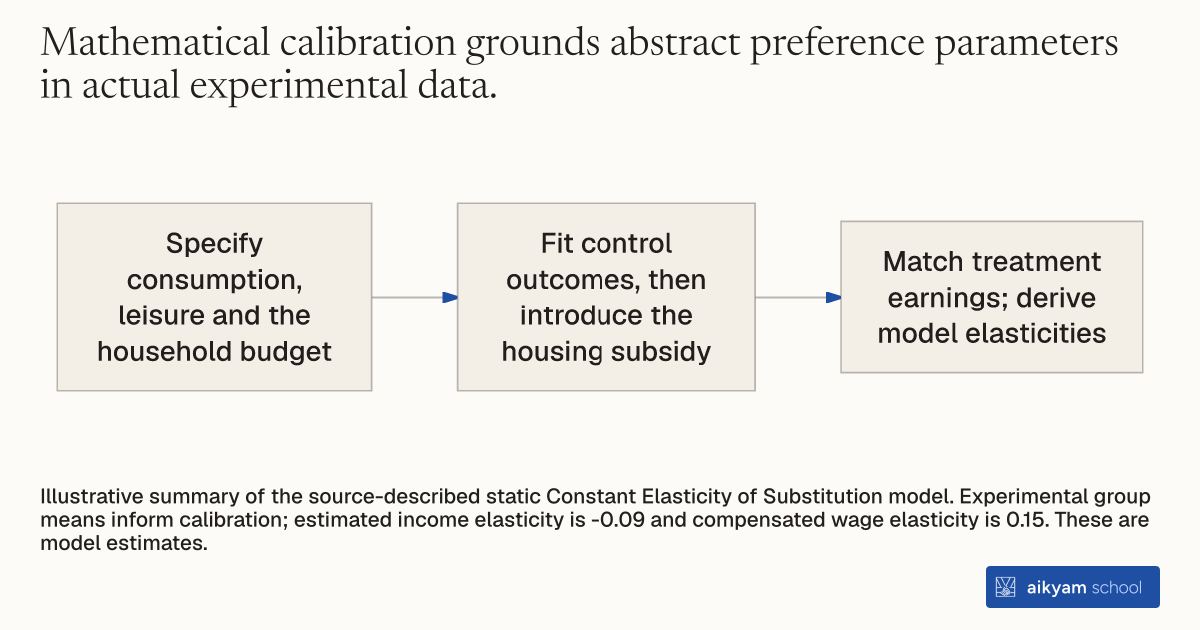
- Specify consumption, leisure and the household budget
- Fit control outcomes, then introduce the housing subsidy
- Match treatment earnings; derive model elasticities
Illustrative summary of the source-described static Constant Elasticity of Substitution model. Experimental group means inform calibration; estimated income elasticity is -0.09 and compensated wage elasticity is 0.15. These are model estimates.
See source →How
When to use
Reduced-form empirical estimates reveal observed program impacts but do not isolate underlying structural preferences. Calibrating a mathematical utility model converts empirical employment shifts into structural labor supply elasticities. This technique allows researchers to simulate behavioral responses under alternative welfare policy designs.
Calibrate a Constant Elasticity of Substitution utility model using experimental treatment and control outcome means.
- Specify a CES utility function combining total consumption goods and non-market leisure hours.
- Define the household budget constraint incorporating labor income, unearned transfer income, post-tax wages, and housing subsidy phase-out rules.
- Plug empirical baseline hours worked, average wages, and non-housing unearned income into the utility maximization framework.
- Solve for the structural preference parameters that align predicted model labor supply with observed control group earnings.
- Introduce the housing subsidy into the budget constraint and calibrate the preference parameters to match observed experimental earnings reductions.
- Calculate compensated wage elasticities and unearned income elasticities from the fitted utility function.
Why it works
Matching model predictions to randomized trial outcomes provides realistic elasticity parameters for policy modeling.
Example
Researchers studying housing voucher lottery winners in Chicago, Illinois, calibrated a static CES labor supply model using experimental outcome means, estimating a compensated wage elasticity of 0.15 and an income elasticity of -0.09.
About the study
Participants
42,358 working-age, able-bodied adults living in private housing in Chicago, Illinois (11,696 treatment group, 30,662 control group).
Study Design
Structural calibration of a static CES utility model using experimental treatment and control group means for post-tax wages, baseline hours, and virtual unearned income.
Results
Model calibration successfully matched experimental labor supply drops, yielding an unearned income elasticity of -0.09 and a compensated wage elasticity of 0.15.