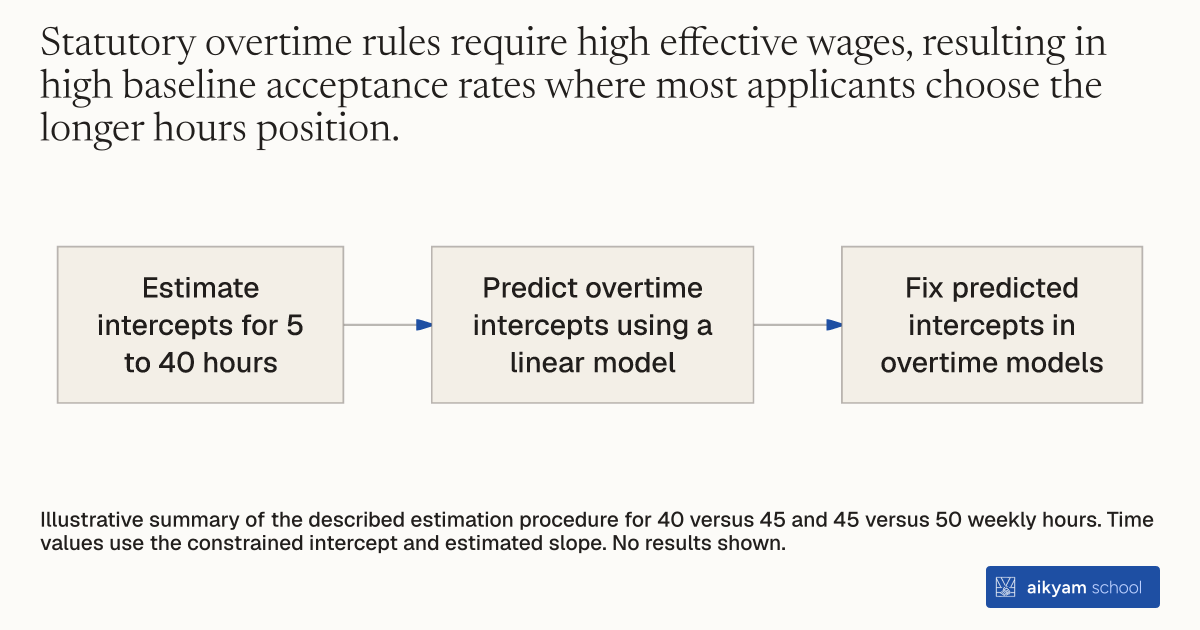
Research steps
Estimate overtime time values
- Estimate intercepts for 5 to 40 hours
- Predict overtime intercepts using a linear model
- Fix predicted intercepts in overtime models
Illustrative summary of the described estimation procedure for 40 versus 45 and 45 versus 50 weekly hours. Time values use the constrained intercept and estimated slope. No results shown.
See source →How
When to use
Researchers estimating labor supply choices over high weekly work hours face statutory overtime wage floors, forcing experimental wages to remain high. This causes severe estimation variance when using unconstrained choice models to evaluate reservation wages above 40 hours per week. Constraining the baseline choice probability intercept using lower-hour estimations stabilizes high-hour reservation wage parameter estimates.
Constrain the choice probability intercept in high-hour logit models using linear predictions from lower work-hour treatments to stabilize overtime parameter estimation.
- Estimate unconstrained logit baseline intercepts for discrete choice treatments across non-overtime work hour comparisons from 5 to 40 hours per week.
- Regress the estimated non-overtime intercepts on average work hours across treatments using linear regression.
- Predict the expected zero-effective-wage choice probability intercept for overtime hours choices at 40 versus 45 hours and 45 versus 50 hours per week.
- Fit logit discrete choice models on overtime wage choices while fixing the intercept term to the linearly predicted values.
- Derive the estimated overtime marginal value of time by dividing the constrained intercept term by the estimated slope coefficient.
Why it works
Allowing lower-hour choice data to inform the zero-wage intercept prevents extreme extrapolation noise while substantially increasing parameter precision.
Example
Researchers evaluated job choices for 40 versus 45 hours and 45 versus 50 hours per week among unemployed jobseekers across 80 U.S. metro areas. Constraining the zero-wage choice intercept using linear extrapolation from 5 to 40-hour choices reduced the standard error of the estimated 40 versus 45 hours marginal value of time from 15.90 dollars to 1.70 dollars.
About the study
Participants
N = 250 unemployed job applicants across 80 U.S. metropolitan areas evaluated in overtime choices (121 for 40 vs 45 hours; 129 for 45 vs 50 hours).
Study Design
Randomized field experiment evaluating choices over overtime hours (40 vs 45 and 45 vs 50 hours/week) with effective wages ranging from 27 to 35 dollars per hour, estimated via logit models with intercepts constrained by linear extrapolation from non-overtime hours treatments.
Results
Unconstrained logit models yield an imprecisely estimated marginal value of time of 43.10 dollars (s.e. = 15.90) for 40 versus 45 hours, whereas imposing linear intercept constraints reduces the standard error tenfold, yielding a precise MVT of 21.89 dollars (s.e. = 1.70) for 40 versus 45 hours and 22.69 dollars (s.e. = 1.54) for 45 versus 50 hours.