Research steps
Measure previous-day work hours
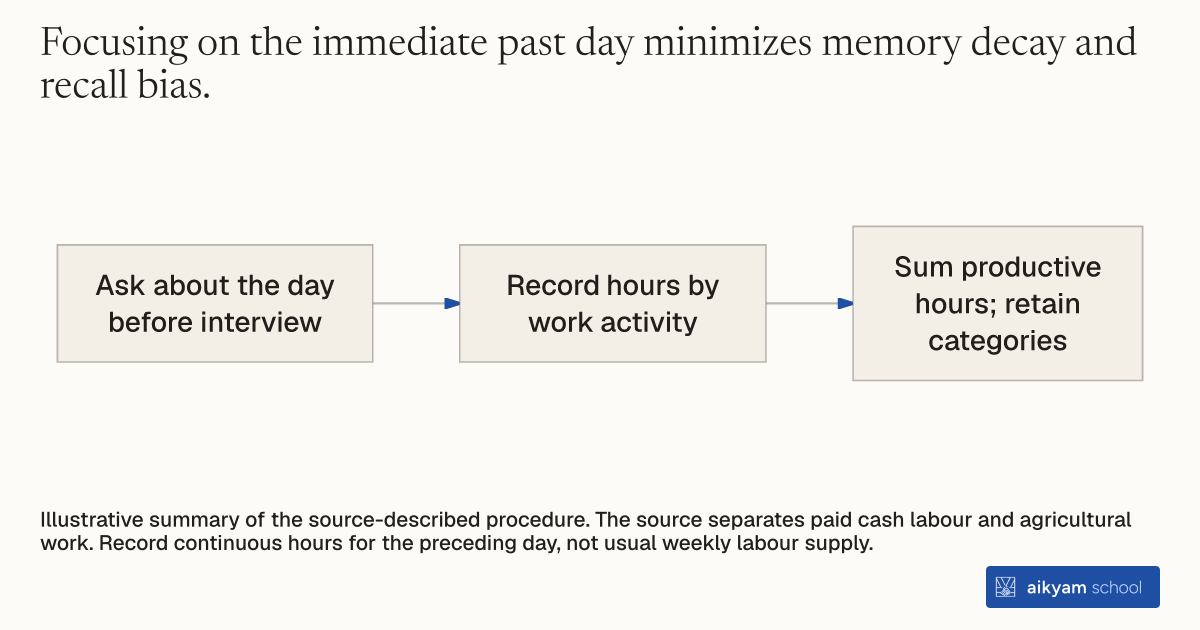
- Ask about the day before interview
- Record hours by work activity
- Sum productive hours; retain categories
Illustrative summary of the source-described procedure. The source separates paid cash labour and agricultural work. Record continuous hours for the preceding day, not usual weekly labour supply.
See source →How
When to use
Measuring labor supply in rural subsistence economies is difficult due to irregular work schedules. Long recall periods introduce memory bias when respondents estimate daily work hours. Eliciting time spent on productive activities during the previous day provides detailed labor supply data for economic evaluation.
Measure individual labor supply by recording exact hours spent on specific activities during the day before the interview.
- Train enumerators to ask respondents about their activities throughout the previous 24-hour day.
- Disaggregate time use into activity categories including paid cash labor and agricultural work.
- Prompt respondents to recall hours devoted to each activity during the preceding day.
- Calculate total daily productive time by summing hours across individual work categories.
- Record continuous labor variables in hours for outcome estimation.
Why it works
Detailed activity categories capture subtle labor adjustments that broad employment questions miss.
Example
Enumerators interviewed 1,734 HIV-negative adults in rural Malawi in 2006 to record time spent working on the day prior to the survey. HIV-negative respondents who learned their test results worked 0.64 hours more on paid cash labor than those who did not learn their results.
About the study
Participants
1,734 HIV-negative adults in rural Malawi (41 percent male, average age 35 years, 4.9 years of education).
Study Design
Instrumental variables linear regression (2SLS) analyzing disaggregated previous-day time use in hours across cash labor and agricultural work, with standard errors clustered by village.
Results
Learning HIV-negative status increased daily cash labor by 0.637 hours (p < 0.05, SE 0.283) relative to a baseline mean of 1.31 hours, but caused a non-significant change of -0.321 hours in agricultural work (SE 0.414).