Research groups
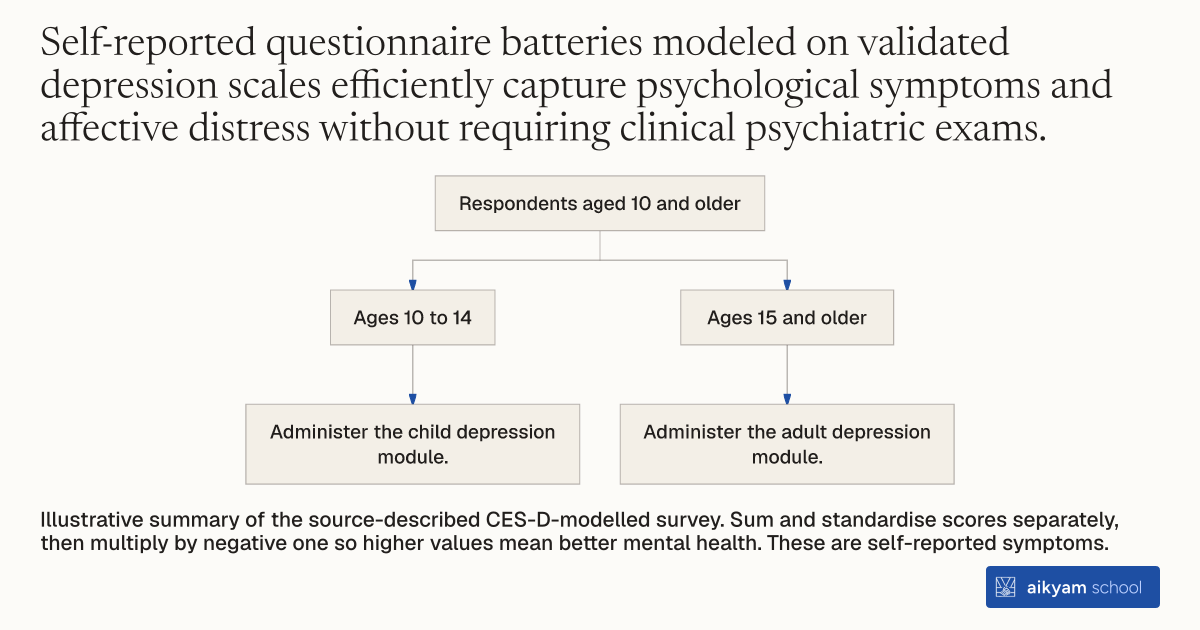
Use age-specific depression questions
Respondents aged 10 and older
- Ages 10 to 14
- Administer the child depression module.
- Ages 15 and older
- Administer the adult depression module.
Illustrative summary of the source-described CES-D-modelled survey. Sum and standardise scores separately, then multiply by negative one so higher values mean better mental health. These are self-reported symptoms.
See source →How
When to use
Poor populations in developing regions often suffer from micronutrient deficiencies like iron deficiency anemia, which can cause fatigue, low productivity, and psychological distress. Public health programs evaluating nutritional interventions need standard field methods to detect shifts in psychological well-being and depression. Administering self-reported depression screening modules allows field teams to evaluate mental health across rural communities.
Screen children and adults for depressive symptoms using standardized self-report questionnaires during household field surveys.
- Identify eligible household respondents aged 10 years and older during field survey visits.
- Select age-appropriate survey modules containing self-reported mental health questions modeled after the CES-D depression index.
- Administer the child depression module to respondents aged 10 to 14 years.
- Administer the adult depression module to respondents aged 15 years and older.
- Sum the responses for each module and standardize the resulting depression scores separately.
- Multiply the standardized score by negative one so higher positive values represent lower depression and better mental health.
Why it works
Standardizing scores within age groups allows researchers to evaluate mental health changes consistently across children and adults.
Example
Survey teams administered CES-D modeled mental health questionnaires to 26,407 individuals aged 10 and older across study villages in Bhojpur district, Bihar. Mental health scores in double-fortified salt sales villages changed by 0.000 standard deviations compared to control villages, showing no effect on depression.
About the study
Participants
26,407 individuals aged 10 years and older across 400 rural villages in Bhojpur district, Bihar, including 4,573 children, 15,557 adults, and 6,269 elderly respondents.
Study Design
Survey teams administered CES-D modeled depression screening modules during household endline surveys across sales, free distribution, and control villages to measure psychological impacts.
Results
Standardized mental health scores showed a change of 0.000 standard deviations in sales villages (95% CI: -0.043 to +0.043 SD) and -0.017 standard deviations in free DFS households compared to control villages (95% CI: -0.082 to +0.048 SD).