Try, learn and adjust
Check film screenings explain local salt access
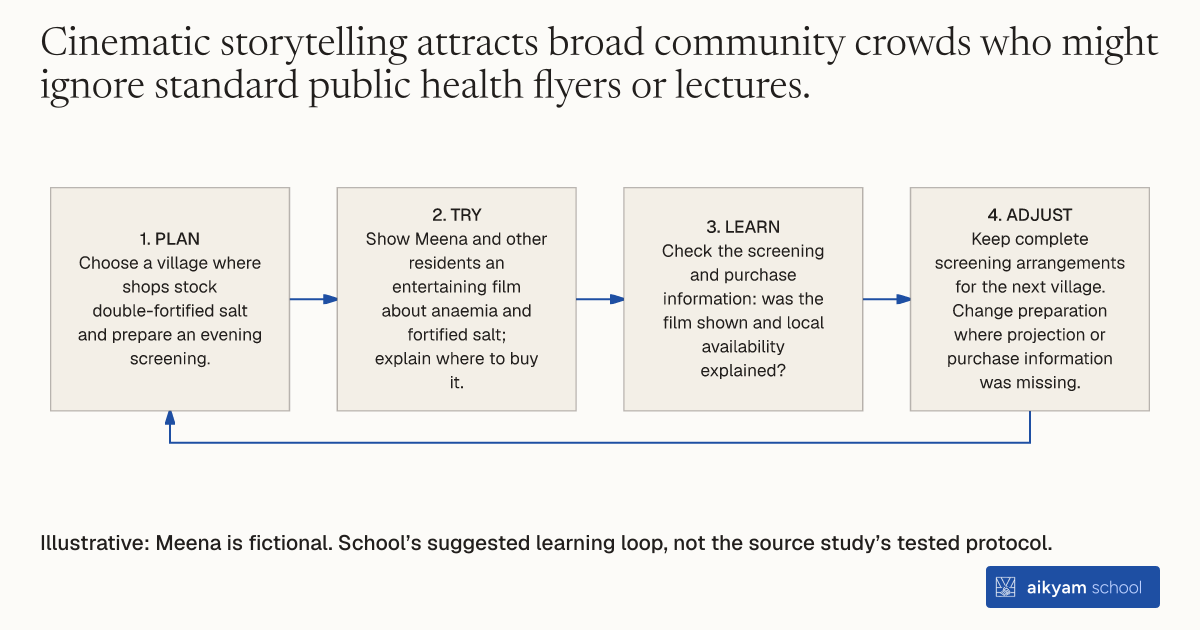
- Plan: Choose a village where shops stock double-fortified salt and prepare an evening screening.
- Try: Show Meena and other residents an entertaining film about anaemia and fortified salt; explain where to buy it.
- Learn: Check the screening and purchase information: was the film shown and local availability explained?
- Adjust: Keep complete screening arrangements for the next village. Change preparation where projection or purchase information was missing.
Illustrative: Meena is fictional. School’s suggested learning loop, not the source study’s tested protocol.
See source →School’s suggested, untested loop. Observe screening delivery and purchase information; do not infer haemoglobin changes from film delivery.
How
When to use
Rural households may hesitate to try unfamiliar nutritional products due to misconceptions or low awareness. Traditional health educational lectures often fail to reach or engage large village audiences. Screening a high-production-value edutainment movie in central community spaces captures local attention and motivates families to purchase new health products.
Screen a custom-produced edutainment film in targeted rural villages to increase community awareness and drive product sales.
- Produce a high-production-value edutainment movie that embeds key health messages about iron deficiency anemia and double-fortified salt within an entertaining storyline.
- Identify rural villages where local shops carry the newly introduced health product.
- Deploy mobile screening equipment and field staff to set up projection units in central village gathering spaces.
- Host public evening movie screenings open to all village residents and community members.
- Provide clear information during the event on where residents can purchase the fortified salt at local shops.
Why it works
Embedding health messages into compelling entertainment helps residents understand nutritional benefits and encourages trial purchases.
Example
In a social marketing experiment across rural villages in Bhojpur district, Bihar, researchers screened a high-production-value edutainment movie in selected sales villages. Showing the film increased current usage of double-fortified salt by approximately 5 percentage points compared to sales villages without screenings.
About the study
Participants
Sub-experiment across 200 sales villages in Bhojpur district, Bihar, evaluating household adoption in communities with a 45 percent baseline anemia rate.
Study Design
Cross-randomized intervention within a cluster randomized trial where an edutainment movie screening was randomly assigned to a subset of sales villages stocking double-fortified salt.
Results
Showing the edutainment movie increased current double-fortified salt usage by about 5 percentage points, though this increased take-up did not produce statistically significant improvements in population hemoglobin or anemia rates.