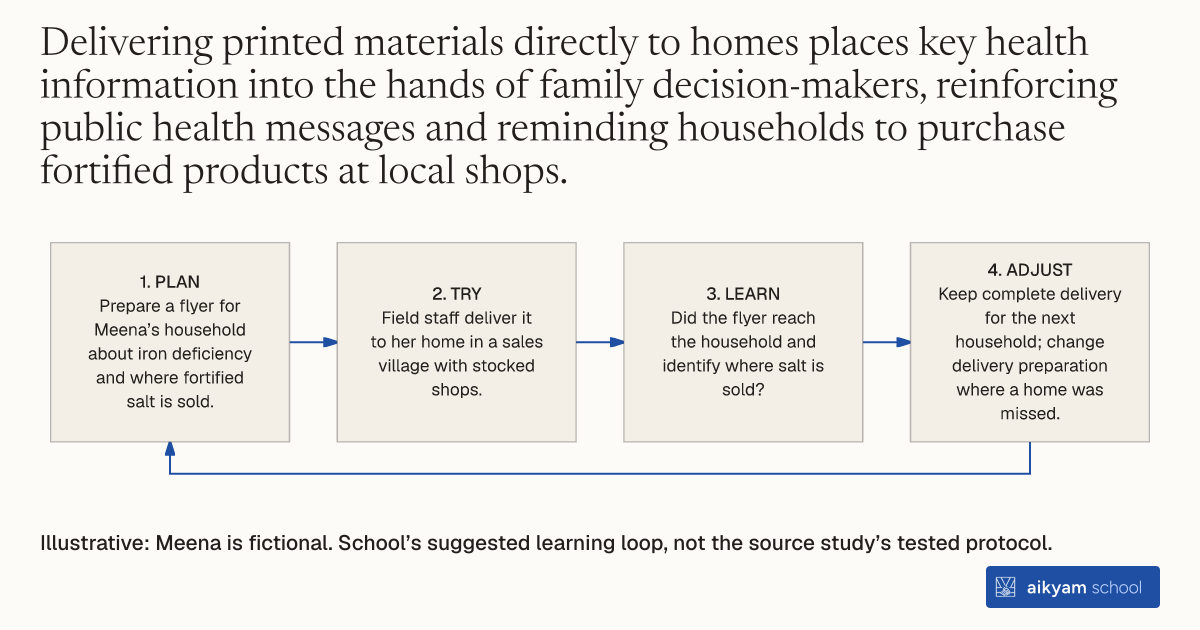
Try, learn and adjust
Check household flyer delivery
- Plan: Prepare a flyer for Meena’s household about iron deficiency and where fortified salt is sold.
- Try: Field staff deliver it to her home in a sales village with stocked shops.
- Learn: Did the flyer reach the household and identify where salt is sold?
- Adjust: Keep complete delivery for the next household; change delivery preparation where a home was missed.
Illustrative: Meena is fictional. School’s suggested learning loop, not the source study’s tested protocol.
See source →School’s suggested learning loop, not a tested source procedure. Observe household flyer receipt and shop information; this does not establish health effects.
How
When to use
In rural health marketing campaigns, village launch events may fail to reach residents who miss public gatherings. Community members may also forget verbal health messages delivered during street plays or shows. Delivering educational flyers directly to homes ensures families receive written information about micronutrient deficiencies and health products.
Distribute printed educational flyers directly to households to increase product awareness and encourage retail purchases.
- Create educational flyers explaining iron deficiency anemia, its health symptoms, and the dietary benefits of fortified salt.
- Identify target sales villages where local grocers and distribution shops maintain stock of double-fortified salt.
- Deploy field staff to visit individual homes across designated treatment villages.
- Hand deliver an educational flyer to each household to inform family members where fortified salt is sold.
Example
In a social marketing trial across rural sales villages in Bhojpur district, Bihar, field staff delivered educational flyers directly to households to encourage double-fortified salt adoption.
About the study
Participants
Sub-experiment across 200 sales villages in Bhojpur district, Bihar, evaluating household take-up in communities with a 45 percent baseline anemia rate.
Study Design
Cross-randomized intervention within a cluster randomized trial where household flyer delivery was randomly assigned across sales villages stocking double-fortified salt.
Results
Social marketing interventions including flyer delivery were evaluated for take-up effects, but sales village interventions yielded no statistically significant increase in overall hemoglobin (0.033 g/dL, 95% CI: -0.024 to +0.09 g/dL) or reduction in anemia (-0.6 percentage points).