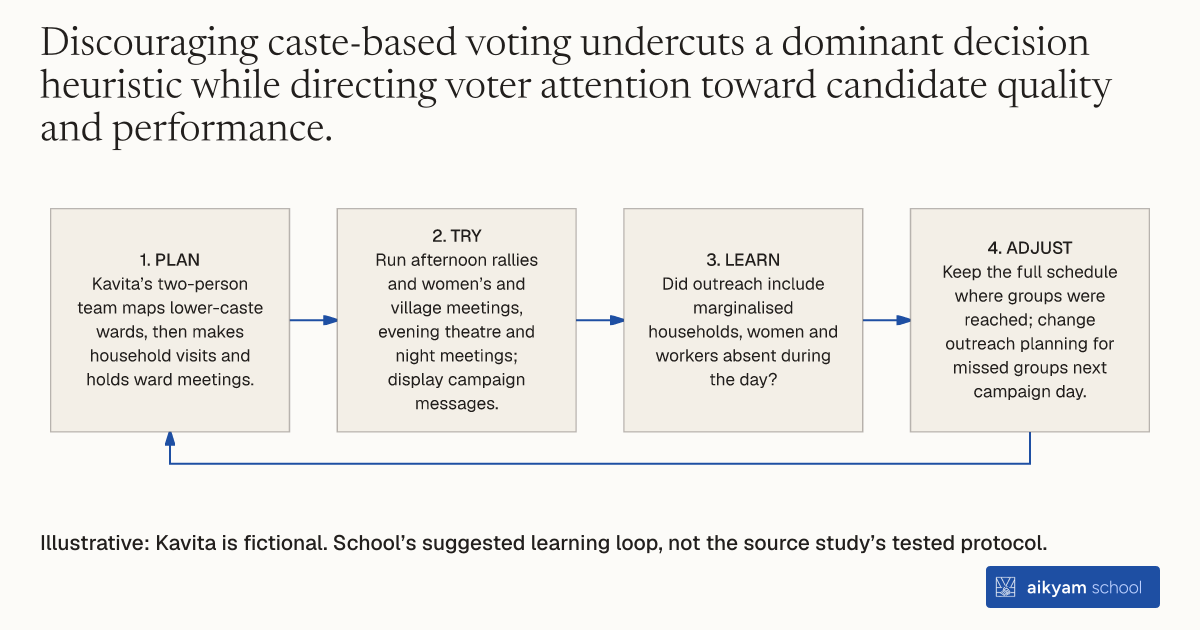
Try, learn and adjust
Check coverage across the campaign day
- Plan: Kavita’s two-person team maps lower-caste wards, then makes household visits and holds ward meetings.
- Try: Run afternoon rallies and women’s and village meetings, evening theatre and night meetings; display campaign messages.
- Learn: Did outreach include marginalised households, women and workers absent during the day?
- Adjust: Keep the full schedule where groups were reached; change outreach planning for missed groups next campaign day.
Illustrative: Kavita is fictional. School’s suggested learning loop, not the source study’s tested protocol.
See source →School’s suggested learning loop, not a tested source procedure. Observe campaign exposure across groups; this loop does not isolate effects of any campaign component.
How
When to use
Low-income voters in developing democracies often rely on identity heuristics like caste to choose political representatives. This reliance leads to weak political accountability and increases the electoral support of candidates charged with serious crimes. A non-partisan priming campaign addresses this by encouraging rural voters to prioritize development and candidate quality over ethnic affiliations.
Deploy a two-person team to conduct an intensive one-day non-partisan campaign in each targeted rural village during the weeks leading up to an election.
- Map the village with local residents in the morning to identify lower-caste wards and structure the day's outreach.
- Conduct door-to-door ward visits prior to meetings to inform elderly, sick, and marginalized residents about campaign messages.
- Hold roughly three ward-level meetings to discuss local infrastructure priorities and emphasize the civic importance of voting.
- Organize an afternoon children's rally where children learn campaign slogans and lead a march through the village.
- Convene targeted meetings with women's self-help groups and hold a main village-level gathering to deliver the core anti-caste development message.
- Display posters in public areas, write slogans on village walls, and host an early evening interactive puppet show depicting the benefits of choosing development-oriented leaders over corrupt caste-based politicians.
- Conduct night meetings for residents who work outside the village during the day.
Why it works
When voters reconsider identity-based choices, they shift away from flawed or criminal candidates because candidate quality becomes a primary evaluative criterion.
Example
In 36 village clusters across three central Uttar Pradesh districts during the 2007 state assembly election, an NGO delivered the one-day campaign to local voters. Male voter registration rose by 7% and male turnout increased by 11%, raising turnout from 60% to roughly 67%. Voting for caste-preferred candidates dropped from 57.6% to 47.6%, and the vote share advantage of candidates charged with heinous crimes was cut in half.
About the study
Participants
The trial covered 36 clusters of 12 to 20 villages across Lalitpur, Bahraich, and Sitapur districts in rural Uttar Pradesh, India, surveying 1,538 Hindu voters (including Scheduled Castes and Other Backward Castes) across treated and control villages.
Study Design
Researchers implemented a randomized cluster field experiment assigning polling-station clusters to the campaign, using an instrumental variables strategy to correct for village-unit assignment spillover rules, and evaluated outcomes using Election Commission polling data and a post-election private ballot household survey.
Results
The campaign increased overall voter turnout by 9% (and male turnout by 11%), reduced lower-caste voting for caste-preferred parties by 12 percentage points, and halved the 65% vote share premium typically enjoyed by candidates charged with heinous crimes.