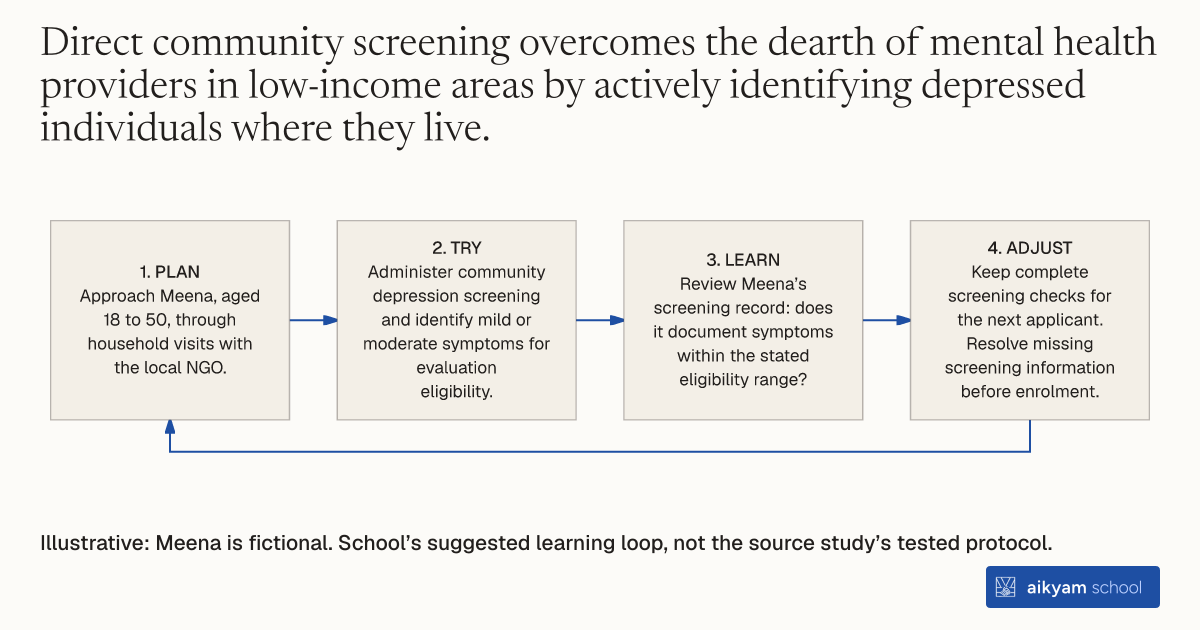
Try, learn and adjust
Check screening eligibility before enrolment
- Plan: Approach Meena, aged 18 to 50, through household visits with the local NGO.
- Try: Administer community depression screening and identify mild or moderate symptoms for evaluation eligibility.
- Learn: Review Meena’s screening record: does it document symptoms within the stated eligibility range?
- Adjust: Keep complete screening checks for the next applicant. Resolve missing screening information before enrolment.
Illustrative: Meena is fictional. School’s suggested learning loop, not the source study’s tested protocol.
See source →School’s suggested, untested loop. Observe screening records and eligibility; screening alone does not establish diagnosis or treatment benefit.
How
When to use
In low-income countries, depression is widespread and costly, but only 15 percent of people with depression receive necessary care. A major barrier is that community demand for care remains unmet due to a lack of screening and providers. Screening adults in local communities identifies individuals suffering from mild or moderate depression who would otherwise lack access to mental healthcare.
Screen adults directly in peri-urban and rural communities to identify individuals with mild or moderate depression symptoms.
- Field staff partner with a local non-governmental organization to enter target communities.
- Staff visit households in peri-urban villages to approach adults aged 18 to 50.
- Workers administer community depression screening tools to evaluate symptom severity.
- Screeners identify participants exhibiting symptoms of mild or moderate depression.
- Staff enroll eligible individuals into healthcare evaluation and support cohorts.
Why it works
This approach connects underserved populations to treatment guarantees established under national mental health policies.
Example
Researchers and Grameena Abudaya Seva Samsthe screened adults across 506 peri-urban villages near Bangalore, India, where 24 percent of adults aged 18 to 50 had depression symptoms. The screening identified and recruited 1,000 adults with mild or moderate depression symptoms, 86 percent of whom were women.
About the study
Participants
1,000 adults aged 18 to 50 with mild or moderate depression symptoms (86 percent women) across 506 peri-urban villages near Bangalore, India.
Study Design
Community-based randomized evaluation screening a representative population across 506 villages, assigning 1,000 screened individuals into four study arms evaluated over 26 months across five survey waves.
Results
Screening identified that 24 percent of adults aged 18 to 50 had depression symptoms and 10 percent had symptoms of at least moderate depression, enabling recruitment of 1,000 participants.