Research steps
Identify hypertension and high risk
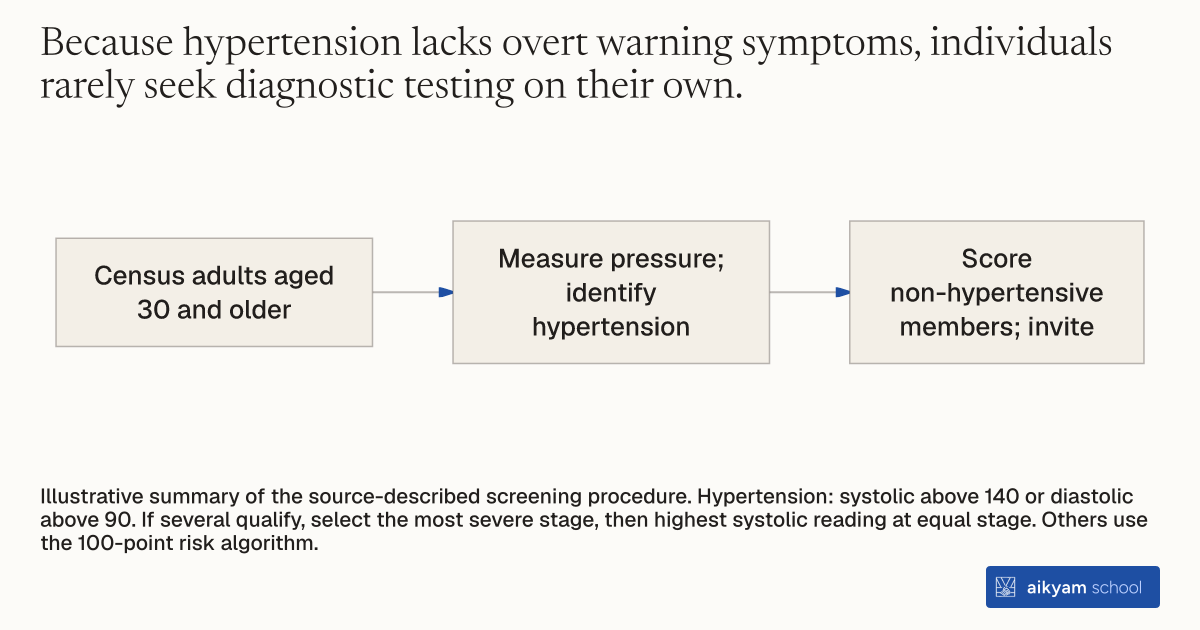
- Census adults aged 30 and older
- Measure pressure; identify hypertension
- Score non-hypertensive members; invite
Illustrative summary of the source-described screening procedure. Hypertension: systolic above 140 or diastolic above 90. If several qualify, select the most severe stage, then highest systolic reading at equal stage. Others use the 100-point risk algorithm.
See source →How
When to use
Hypertension and its risk factors often remain undiagnosed in rural areas due to a lack of everyday symptoms. Health providers need a systematic way to identify hypertensive and high-risk individuals in low-income populations for targeted preventive care. This method screens households to diagnose individuals above age 30 who require regular monitoring.
Screen every adult household member above age 30 in a target community using automated blood pressure measurements and a risk-scoring algorithm to identify hypertensive and high-risk individuals.
- Enumerators conduct a door-to-door household census across target villages to reach all adults aged 30 and older.
- Enumerators measure each household member's blood pressure using an automatic measurement device.
- Enumerators classify individuals with systolic blood pressure above 140 or diastolic blood pressure above 90 as hypertensive.
- If multiple household members have hypertension, enumerators select the member with the most severe stage, or the highest systolic reading if at the same stage.
- Enumerators evaluate non-hypertensive members using a 100-point risk score algorithm based on age, gender, family history of hypertension and diabetes, tobacco use, physical activity, and waist circumference.
- Enumerators invite identified hypertensive and high-risk individuals to enroll in the health program.
Why it works
Universal door-to-door screening with objective biometric measurements identifies undiagnosed patients and connects them to preventive care.
Example
In 2012 across 4 rural villages in Punjab, India, enumerators screened 20,824 individuals from 4,028 households. They identified 2,004 households with at least one hypertensive member and 276 households with a high-risk member, inviting 2,280 households and enrolling 1,725 respondents in the study.
About the study
Participants
20,824 individuals screened across 4,028 households in 4 rural villages in Punjab, India, yielding 1,725 enrolled respondents (59% female, average age 53.7 years).
Study Design
Universal household census screening using Citizen CH-452 automatic blood pressure monitors combined with a 100-point hypertension risk score algorithm for non-hypertensive adults aged 30 and above.
Results
Identified 2,004 hypertensive households and 276 high-risk households, with 1,725 out of 2,280 invited households (75.7%) accepting study participation; baseline screening showed 58% hypertension prevalence and 86% pre-hypertension among enrolled participants.