Try, learn and adjust
Check official clinic fees and revenue use
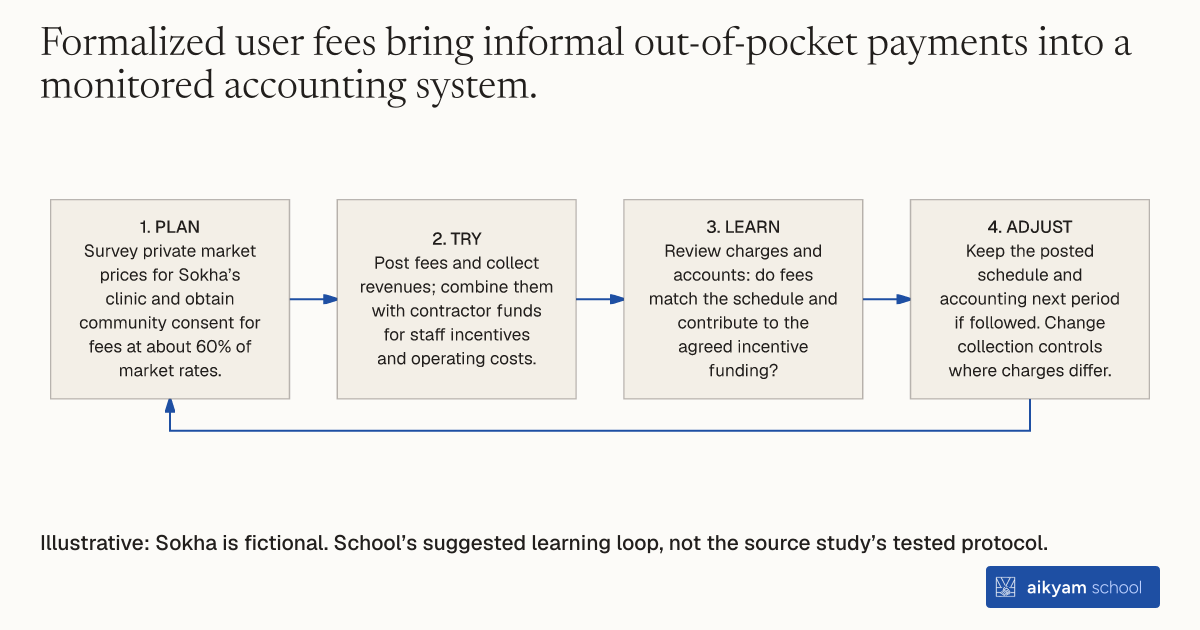
- Plan: Survey private market prices for Sokha’s clinic and obtain community consent for fees at about 60% of market rates.
- Try: Post fees and collect revenues; combine them with contractor funds for staff incentives and operating costs.
- Learn: Review charges and accounts: do fees match the schedule and contribute to the agreed incentive funding?
- Adjust: Keep the posted schedule and accounting next period if followed. Change collection controls where charges differ.
Illustrative: Sokha is fictional. School’s suggested learning loop, not the source study’s tested protocol.
See source →School’s suggested, untested loop. Observe fees and revenue use. In Pereang, user fees covered approximately half of staff incentive payments; do not generalise that share to every clinic.
How
When to use
Public health clinics in developing countries face unauthorized fee collection and informal staff charges. Patients pay high out-of-pocket costs to unregulated private vendors while public clinics lack revenue for basic operations. Formalize user fees with community consent to standardize patient charges and fund health worker incentives.
Implement a community-approved official user-fee schedule to capture informal health spending and finance clinic operations.
- Determine local private medical market prices through baseline surveys of private practitioners and drug vendors.
- Set official public health service prices at approximately 60% of prevailing market rates with community consent.
- Post official price schedules prominently at health facility entrances to prevent staff from overcharging.
- Collect user-fee revenues at facilities to pay for approximately half of health staff salary incentives.
- Combine collected user fees with contractor budget supplements to fund remaining staff incentives and operating costs.
Why it works
Setting prices below private market rates makes private practice less attractive to staff while protecting patients from arbitrary charges.
Example
HealthNet International established an official user-fee system in Pereang district of Prey Veng province between 1999 and 2003. Prices set at 60% of market rates covered 50% of staff incentive payments, while clear price posting increased by 24 percentage points over the 77% comparison average.
About the study
Participants
12 rural districts across Takeo, Prey Veng, and Kampong Cham provinces in Cambodia, covering 1.26 million residents across 360 sample villages with 3,700 households and 143 health centers.
Study Design
Cluster-randomized trial evaluating 12 districts randomly assigned to contracting out, contracting in, or comparison status, using initial random eligibility as an instrumental variable for actual contract rollout.
Results
User fees covered 50% of staff incentive payments in Pereang district, formal user fees expanded to 71% of comparison facilities by 2003, contracting in increased clear posting of fees by 24 percentage points, and contracting out reduced annualized out-of-pocket spending by \$55.86.