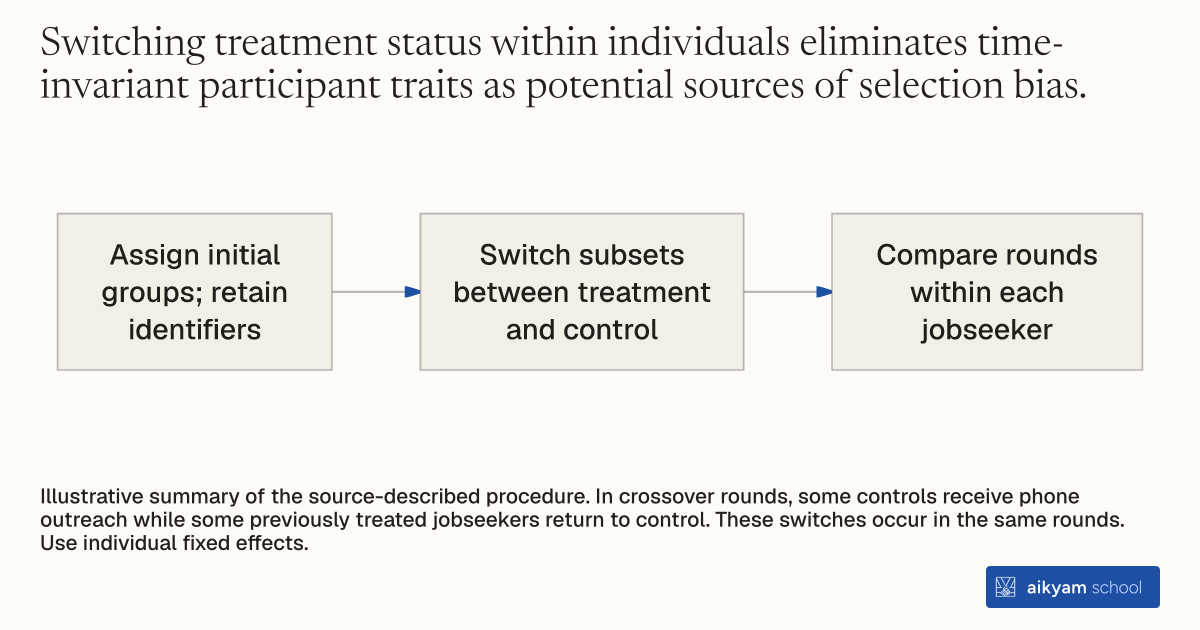
Research steps
Compare the same jobseekers across rounds
- Assign initial groups; retain identifiers
- Switch subsets between treatment and control
- Compare rounds within each jobseeker
Illustrative summary of the source-described procedure. In crossover rounds, some controls receive phone outreach while some previously treated jobseekers return to control. These switches occur in the same rounds. Use individual fixed effects.
See source →How
When to use
Evaluators measuring program impact often face unobserved individual-level heterogeneity that confounds differences between participants and non-participants. Re-assigning treatment status across distinct intervention rounds creates within-subject variation that controls for fixed individual characteristics. It is intended for platform researchers evaluating behavioral interventions where treatment can be turned on and off over time.
Evaluate intervention effects by alternating treatment status across subject matching rounds to compare within-individual outcomes over time.
- Assign participants to baseline treatment and control groups during initial intervention rounds.
- Maintain individual participant identifiers across consecutive platform matching rounds.
- Switch a subset of control participants to receive the proactive intervention in subsequent rounds.
- Return a subset of previously treated participants to the control condition in those same rounds.
- Estimate regression models featuring individual fixed effects to compare outcomes across treated and untreated rounds for the same individual.
Why it works
This isolates whether behavioral responses stem from temporary intervention prompts rather than permanent individual ability or motivation differences.
Example
In Lahore, Pakistan, researchers implemented a crossover design across 1,116,952 matches where control jobseekers were re-assigned to phone call outreach in specific platform rounds. The within-jobseeker analysis confirmed that individual jobseekers achieved similar interview returns during treated rounds compared to their own untreated rounds.
About the study
Participants
N = 9,838 jobseekers (1,116,952 jobseeker-vacancy matches) in Lahore, Pakistan; jobseekers participated across multiple monthly matching rounds over four years.
Study Design
Crossover randomized trial re-assigning control jobseekers to phone call treatment across rounds, analyzed using jobseeker fixed effects regressions.
Results
Within-jobseeker crossover estimates showed that marginal applications induced by treatment during treated rounds achieved interview rates statistically indistinguishable from applications in untreated rounds (p = 0.503 for interview probability, p = 0.480 for value-weighted interviews).