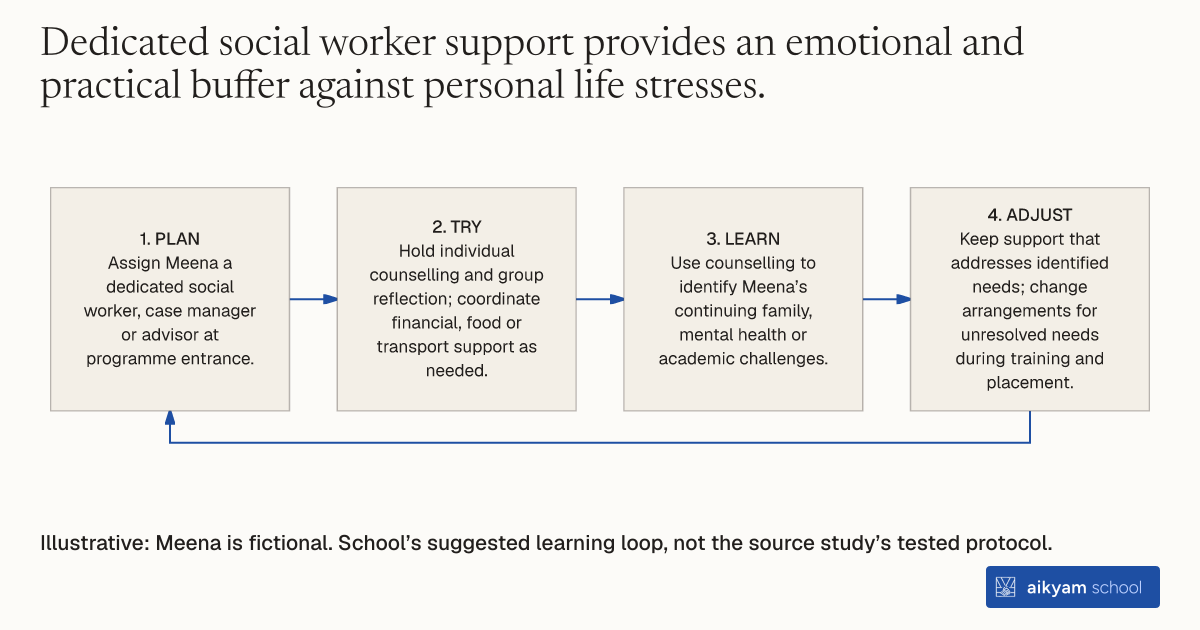
Try, learn and adjust
Check personal support during workforce training
- Plan: Assign Meena a dedicated social worker, case manager or advisor at programme entrance.
- Try: Hold individual counselling and group reflection; coordinate financial, food or transport support as needed.
- Learn: Use counselling to identify Meena’s continuing family, mental health or academic challenges.
- Adjust: Keep support that addresses identified needs; change arrangements for unresolved needs during training and placement.
Illustrative: Meena is fictional. School’s suggested learning loop, not the source study’s tested protocol.
See source →School’s suggested learning loop, not a tested protocol. Observe counselling feedback and continuing support needs.
How
When to use
Low-income job seekers often face personal, emotional, or social barriers during demanding workforce training programs. Without dedicated personal guidance, life shocks can cause participants to fall behind and drop out. Program staff solve this problem by assigning social workers and case managers to provide personal counseling and individual support.
Assign dedicated social workers and case managers to provide continuous personal support and counseling during workforce training.
- Assign every enrolled participant to a dedicated social worker, case manager, or advisor upon program entrance.
- Conduct regular one-on-one counseling sessions to discuss personal challenges, mental health, family needs, or academic stress.
- Coordinate wraparound social support services including emergency financial assistance, food support, and transportation passes.
- Lead group reflection and support meetings to help participants manage personal challenges and stay motivated.
- Provide continuous guidance throughout classroom instruction, internships, and initial job placement.
Why it works
Giving participants access to professional counseling prevents personal crises from derailing program completion.
Example
YearUp assigned professional social workers and advisors to support urban youth across national program sites throughout six months of classroom instruction and six months of corporate internships.
About the study
Participants
Human urban youth aged 18 to 24 participating in national YearUp cohorts across US metropolitan areas.
Study Design
Multi-site Randomized Controlled Trial (RCT) evaluated by Fein et al. (2018, 2021) assessing earnings, employment, and benefit-cost returns over five years.
Results
Social worker case management and wraparound supports helped youth complete training, yielding a $7,011 annual earnings increase (a 40 percent increase, p < 0.01) by Year 3 and a net public benefit of $15,349 per participant by Year 5.