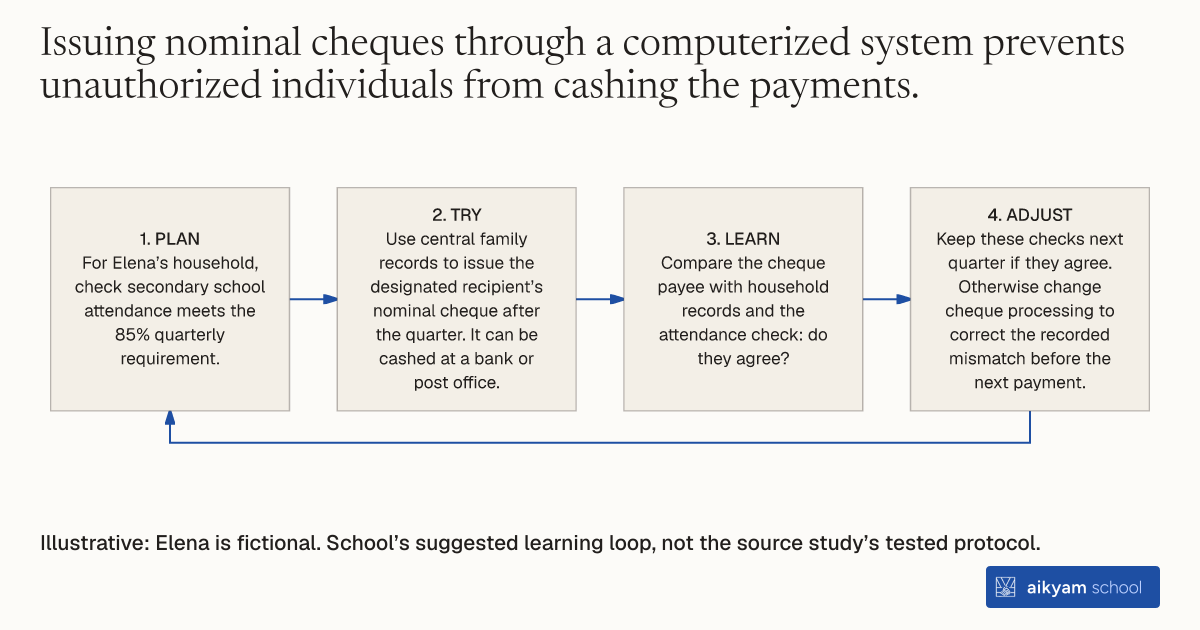
Try, learn and adjust
Check quarterly cheques follow attendance and recipient rules
- Plan: For Elena’s household, check secondary school attendance meets the 85% quarterly requirement.
- Try: Use central family records to issue the designated recipient’s nominal cheque after the quarter. It can be cashed at a bank or post office.
- Learn: Compare the cheque payee with household records and the attendance check: do they agree?
- Adjust: Keep these checks next quarter if they agree. Otherwise change cheque processing to correct the recorded mismatch before the next payment.
Illustrative: Elena is fictional. School’s suggested learning loop, not the source study’s tested protocol.
See source →School’s suggested learning loop, not a source-tested procedure. Observe attendance checks and cheque payees. The programme paid 12,000 MKD annually in four quarterly instalments.
How
When to use
Social welfare programs require reliable mechanisms to deliver cash transfers to specific intended recipients. Direct cash distribution can introduce security risks or administrative errors regarding recipient identity. Issuing computerized nominal cheques after attendance checks ensures funds reach designated recipients securely each quarter.
Disburse conditional cash transfers quarterly using automated nominal cheques processed through local banks and post offices.
- Track student secondary school attendance at the end of each school quarter.
- Verify that the student met the 85 percent attendance requirement for the quarterly school period.
- Access household family composition records stored in the central computerized social protection system.
- Generate a computerized nominal cheque made out specifically to the designated recipient in the household.
- Issue the quarterly transfer payment immediately after the school quarter finishes and attendance checks complete.
- Deliver the nominal cheque to the recipient to cash at local bank branches or post offices.
Why it works
Computerized records linked to social welfare data enforce strict compliance with recipient gender guidelines.
Example
In Macedonia, the Ministry of Labour and Social Policy disbursed conditional cash transfers of 12000 MKD per year in four quarterly instalments starting in 2010. During the first two years, administrators issued computerized nominal cheques cashed at banks or post offices. Across 84 municipalities, 72 percent of eligible households enrolled and received payments under this payment processing system.
About the study
Participants
1053 households with children aged 14 to 18 sampled at baseline across 84 municipalities in Macedonia, with 830 households followed up after two years. Households averaged 4.5 members and 55 percent were Muslim.
Study Design
A randomized trial across all 84 municipalities in Macedonia, stratified by population size into 42 mother-recipient municipalities and 42 household-head-recipient municipalities. Evaluation surveys collected baseline data in 2010 and follow-up data in 2012.
Results
Processing payments via nominal cheques maintained full compliance with municipality gender targeting rules. Paying transfers to mothers increased the household budget share spent on food by 4 to 5 percentage points, while overall program take-up reached 72 percent.