Research steps
Build a formal employer sampling list
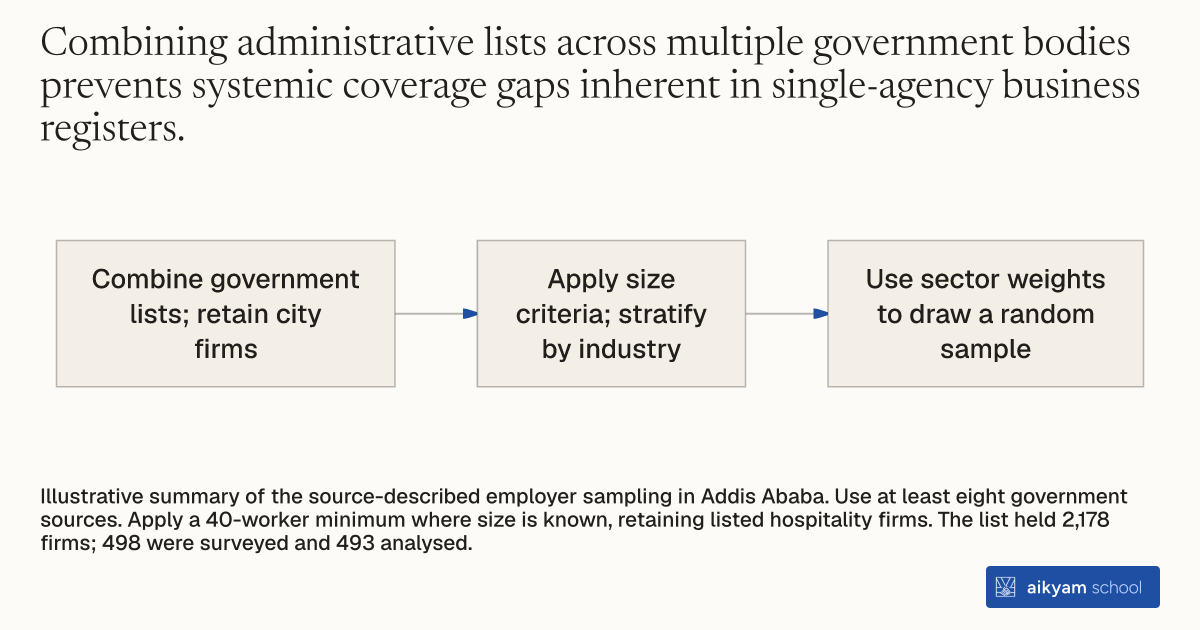
- Combine government lists; retain city firms
- Apply size criteria; stratify by industry
- Use sector weights to draw a random sample
Illustrative summary of the source-described employer sampling in Addis Ababa. Use at least eight government sources. Apply a 40-worker minimum where size is known, retaining listed hospitality firms. The list held 2,178 firms; 498 were surveyed and 493 analysed.
See source →How
When to use
Use this method when constructing a representative sample of formal employers in urban developing economies where no single comprehensive business census exists. It resolves the problem of incomplete government business registries when targeting formal firms across multiple economic sectors. It serves researchers, sector planners, and development organizations measuring firm recruitment and labor demand.
Compile a comprehensive list of formal employers by aggregating administrative records across government agencies before drawing a stratified representative sample.
- Gather administrative employer directories from at least eight distinct government sources, including sectoral ministry registries and statistical agency surveys.
- Filter the compiled directory to keep formal firms located within the targeted metropolitan area.
- Apply a minimum workforce threshold of 40 workers whenever firm size data is available, while retaining listed hospitality firms to preserve sector coverage.
- Stratify the compiled firm registry across major industry categories including manufacturing, construction, financial services, hospitality, and health or education.
- Assign sector-level sampling weights using representative labor force data to mirror the true citywide distribution of formal employers.
- Draw a randomized sample of target firms using sector-weighted probabilities to represent large employers in the city.
Why it works
Stratifying with labor-force weights ensures the resulting firm sample accurately reflects actual sectoral employment shares.
Example
Researchers in Addis Ababa, Ethiopia compiled records from more than eight government directories to build a list of 2,178 large formal firms, applying a 40-employee minimum cutoff. They drew a representative sample of 498 firms across five major sectors, with an average workforce size of 171.5 employees per firm.
About the study
Participants
N = 498 formal sector firms (493 analyzed; average firm size 171.5 employees) across five industry sectors in Addis Ababa, Ethiopia.
Study Design
Multi-source administrative frame compilation with sector-weighted stratified sampling and minimum firm-size filtering.
Results
Aggregated 2,178 candidate firms from over eight ministry directories, surveyed 498 representative employers with 171.5 mean staff, and achieved baseline balance across turnover, sales, and starting salaries.