Research steps
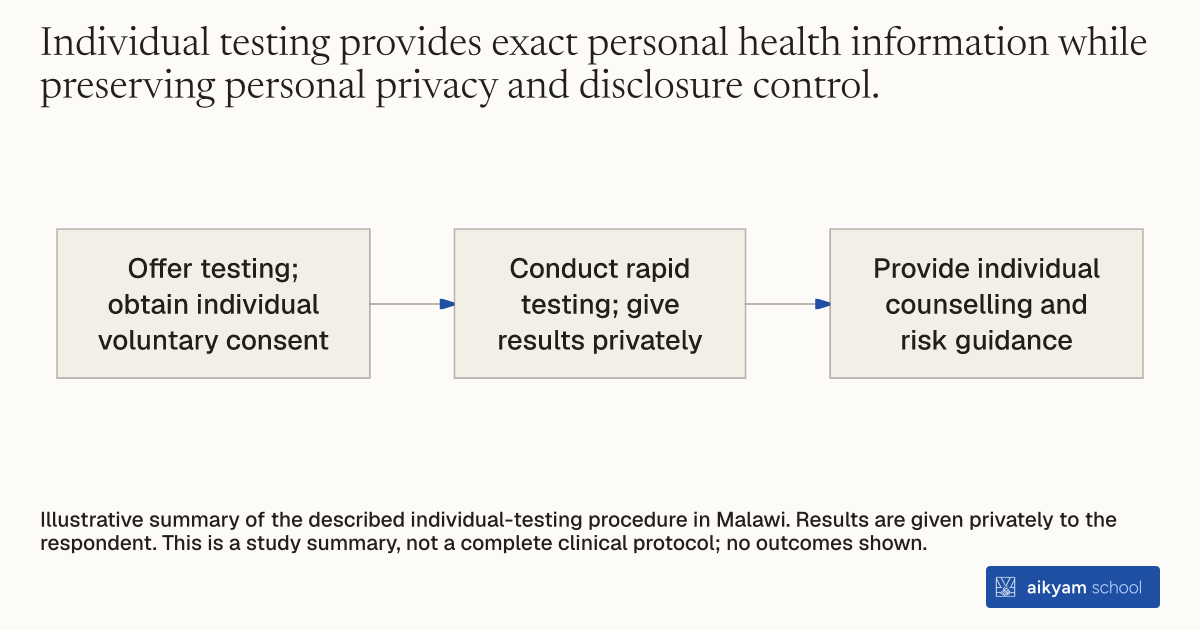
Describe individual HIV testing
- Offer testing; obtain individual voluntary consent
- Conduct rapid testing; give results privately
- Provide individual counselling and risk guidance
Illustrative summary of the described individual-testing procedure in Malawi. Results are given privately to the respondent. This is a study summary, not a complete clinical protocol; no outcomes shown.
See source →How
When to use
Married individuals in high HIV prevalence areas seek to learn their HIV status privately without sharing results with their partner. Individual testing informs a single spouse of their health status while keeping test results confidential. This method serves married adults who want personal testing without requiring joint participation or partner disclosure.
Offer voluntary HIV counseling and testing to married adults separately as individuals in their home villages.
- Field staff visit married respondents in their home villages and offer individual HIV testing.
- Program staff obtain voluntary consent from each participant individually before testing.
- Health workers conduct rapid HIV testing for the individual respondent.
- Counselors inform the respondent of their HIV test result in private.
- Program staff provide individual health counseling and risk reduction guidance tailored to the participant's result.
Why it works
However, because it leaves the spouse's HIV status unknown, it fails to resolve uncertainty about infection risk within the marriage.
Example
Researchers offered individual HIV testing and counseling to married respondents in rural Malawi, where 5.1 percent of individually tested individuals divorced over the following two years.
About the study
Participants
1095 married individuals in rural Malawi, with an average age of almost 36 years and less than 1 year of formal education.
Study Design
A randomized field experiment comparing married respondents randomly assigned to receive HIV counseling and testing either separately as individuals or together as a couple.
Results
Marital dissolution reached 5.1 percent over two years among individuals tested separately, compared to 1.4 percent among those tested together as a couple.