Research procedure
Test distance to results centres
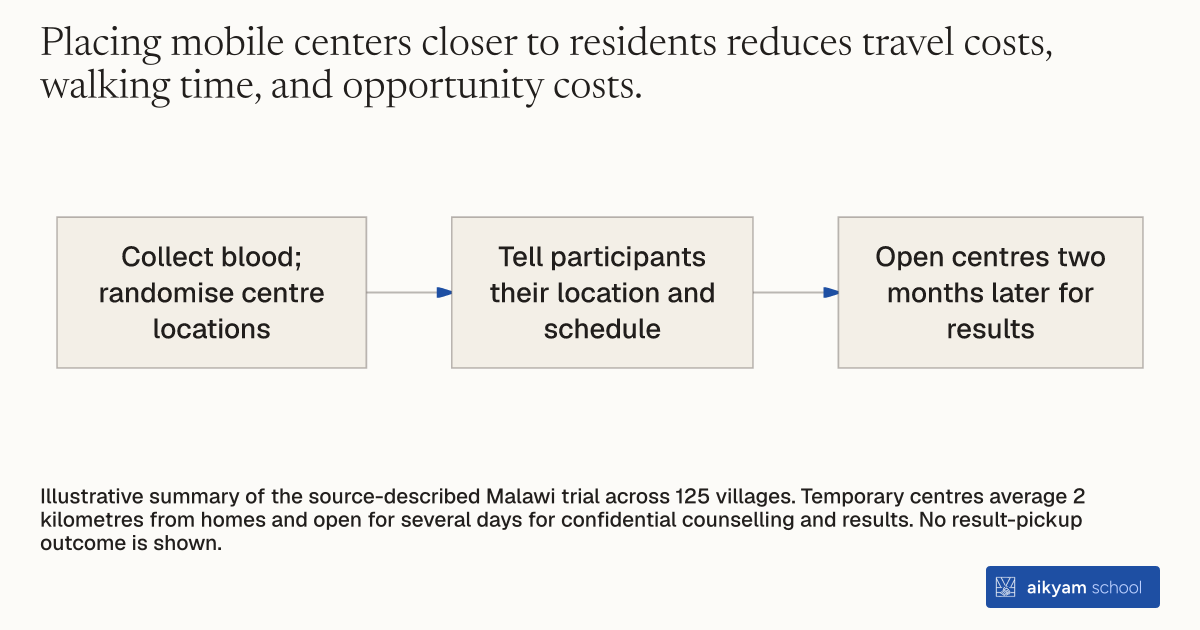
- Collect blood; randomise centre locations
- Tell participants their location and schedule
- Open centres two months later for results
Illustrative summary of the source-described Malawi trial across 125 villages. Temporary centres average 2 kilometres from homes and open for several days for confidential counselling and results. No result-pickup outcome is shown.
See source →How
When to use
Rural populations face long walking distances to permanent health clinics to receive HIV test results. High physical distance creates travel costs and time burdens that deter people from picking up their test results. Strategically placing mobile counseling centers closer to residents provides convenient access for tested individuals in rural villages.
Place temporary mobile counseling centers at randomized distances within rural communities to reduce physical travel barriers to obtaining health results.
- Field staff conduct door-to-door HIV testing and collect blood samples in rural villages.
- Field staff randomly assign mobile counseling center locations across villages at varying distances from participants' homes, averaging two kilometers away.
- Field staff inform participants of the specific location and opening schedule of their designated mobile results center.
- Clinic staff construct temporary mobile counseling tents in designated village locations two months after blood collection.
- Clinic staff remain stationed at mobile centers for several days to provide confidential post-test counseling and deliver results when participants arrive.
Why it works
Lowering physical distance removes friction and makes result collection far more accessible.
Example
Researchers set up temporary mobile counseling centers across 125 rural villages in Malawi at an average distance of two kilometers from respondents' homes. Among 1,734 HIV-negative participants, greater walking distance decreased participation, with each additional kilometer reducing result pickup by 2.7 percentage points.
About the study
Participants
1,813 rural Malawian adults across 125 villages (41 percent male, average age 35 years, 4.9 years of education).
Study Design
Randomized field experiment varying distance to temporary mobile counseling centers to evaluate how physical distance impacts HIV test result collection.
Results
Each additional kilometer of distance from a participant's home to the mobile center decreased result pickup by 2.7 percentage points for HIV-negative individuals and 13.0 percentage points for HIV-positive individuals.