Try, learn and adjust
Check free fortified salt availability
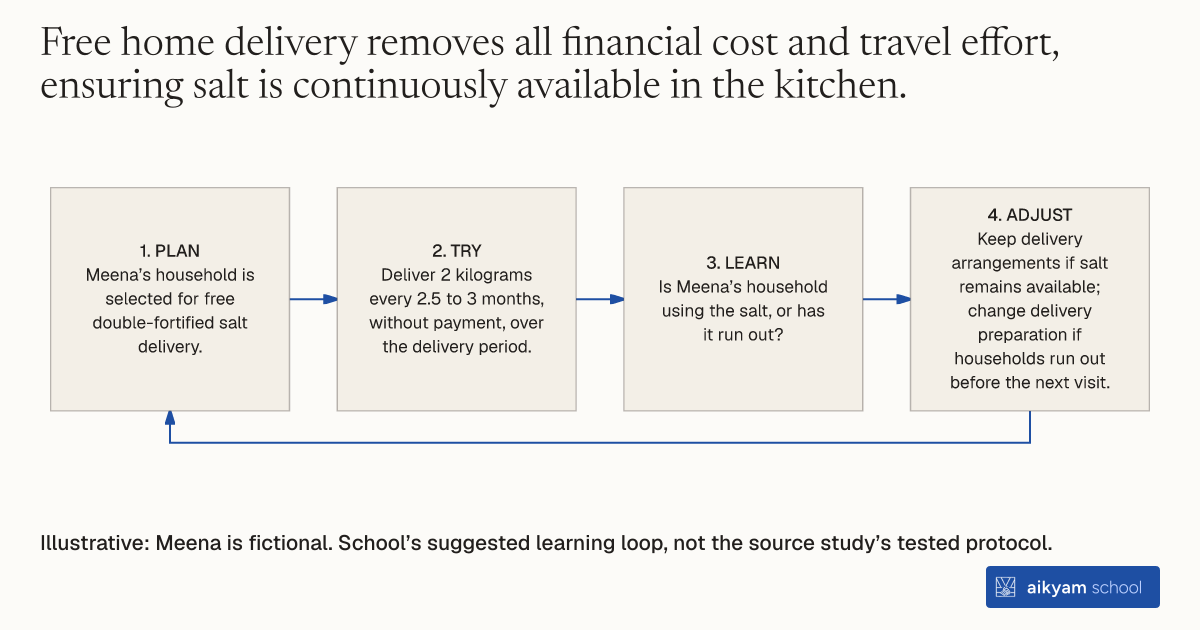
- Plan: Meena’s household is selected for free double-fortified salt delivery.
- Try: Deliver 2 kilograms every 2.5 to 3 months, without payment, over the delivery period.
- Learn: Is Meena’s household using the salt, or has it run out?
- Adjust: Keep delivery arrangements if salt remains available; change delivery preparation if households run out before the next visit.
Illustrative: Meena is fictional. School’s suggested learning loop, not the source study’s tested protocol.
See source →School’s suggested learning loop, not a tested source procedure. Observe salt receipt, current use and running out. The study found no statistically significant haemoglobin or anaemia effect.
How
When to use
In rural communities, many poor families cannot afford or choose not to buy fortified food products even at subsidized prices. Public health initiatives struggle with low product adoption when households must purchase items out of pocket. Delivering double-fortified salt directly to homes for free removes financial and geographic purchase barriers for vulnerable rural families.
Distribute free double-fortified salt directly to rural households to maximize product availability and iron intake.
- Select target rural villages and randomly identify households to receive free fortified salt.
- Procure double-fortified salt containing 1 mg of iron and 40 micrograms of iodine per gram from a licensed manufacturer.
- Deploy a dedicated delivery team to visit selected homes every 2.5 to 3 months.
- Hand over 2 kilograms of double-fortified salt per household during each delivery visit over a two-year period.
- Provide the salt without payment or purchasing obligations to encourage direct household consumption.
Why it works
Consuming fortified salt daily provides micronutrients during normal meals without requiring conscious habit changes.
Example
Field teams delivered 2 kilograms of free double-fortified salt every 2.5 to 3 months to 438 households across 62 villages in Bhojpur district, Bihar over nearly two years. At endline, 61 percent of recipient households were currently using the salt and 75 percent were using it or had just recently run out.
About the study
Participants
438 households receiving free DFS across 62 villages in Bhojpur district, Bihar, compared with control households, with an average baseline age of 27 years and a 45 percent baseline anemia rate.
Study Design
Cluster randomized evaluation embedded within a sales trial, where 7 out of 15 measurement households per village in 62 sales villages were randomly assigned to receive free doorstep salt deliveries over nearly 24 months, with hemoglobin tested via HemoCue blood testing.
Results
Free distribution did not produce a statistically significant change in hemoglobin (-0.007 g/dL compared to non-free households in the same villages, 95% CI: -0.093 to +0.079 g/dL) or in anemia prevalence (-0.003 or -0.3 percentage points, 95% CI: -0.031 to +0.025).