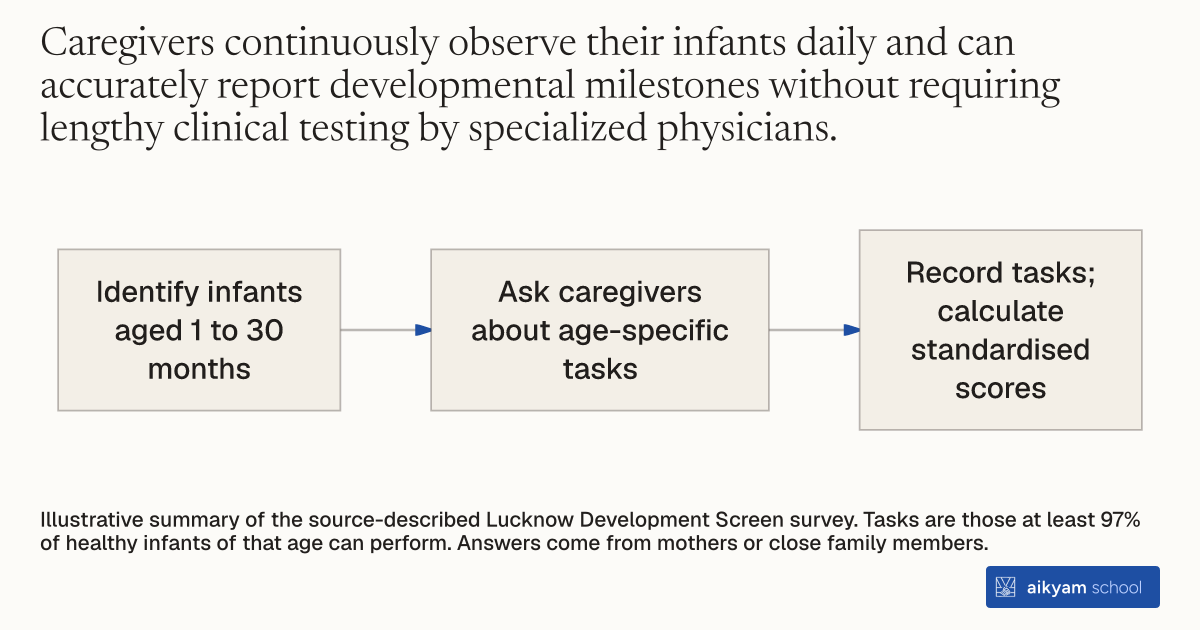
Research steps
Ask caregivers about infant development
- Identify infants aged 1 to 30 months
- Ask caregivers about age-specific tasks
- Record tasks; calculate standardised scores
Illustrative summary of the source-described Lucknow Development Screen survey. Tasks are those at least 97% of healthy infants of that age can perform. Answers come from mothers or close family members.
See source →How
When to use
Public health programs evaluating early childhood nutrition need reliable tools to detect developmental delays in young infants. Standardized clinical exams in medical clinics can be difficult to conduct across rural home visits. Assessing infants using validated developmental screens based on caregiver reporting allows field survey teams to measure infant cognitive and motor progress directly in village households.
Assess infant developmental progress using a validated screening tool based on caregiver reports during field surveys.
- Identify all infants between 1 and 30 months of age living in surveyed rural households.
- Select age-appropriate screening tasks where at least 97 percent of healthy infants at that specific age can perform the task.
- Interview the child's mother or another close family member during a home visit.
- Ask the primary caregiver to report whether the infant can perform each designated age-appropriate task.
- Record completed tasks to calculate a standardized infant developmental score.
Why it works
Using tasks that 97 percent of healthy infants master at a given age ensures clear identification of developmental delays.
Example
Survey teams administered the Lucknow Development Screen to assess developmental delays among 1,506 infants aged 1 to 30 months across rural study villages in Bhojpur district, Bihar. Cognition scores for infants in sales treatment villages were 0.088 standard deviations higher than control infants, though the effect was not statistically significant.
About the study
Participants
1,506 infants aged 1 to 30 months across rural villages in Bhojpur district, Bihar, where 3.2 percent of baseline study individuals were infants.
Study Design
Survey staff interviewed mothers or close family members using the Lucknow Development Screen during household endline surveys to evaluate early childhood cognitive development across sales, free distribution, and control villages.
Results
In the sales experiment, infant standardized cognition scores showed a statistically insignificant point estimate of +0.088 standard deviations (95% CI: -0.010 to +0.186 SD, Q-value = 0.129) compared to control group infants.