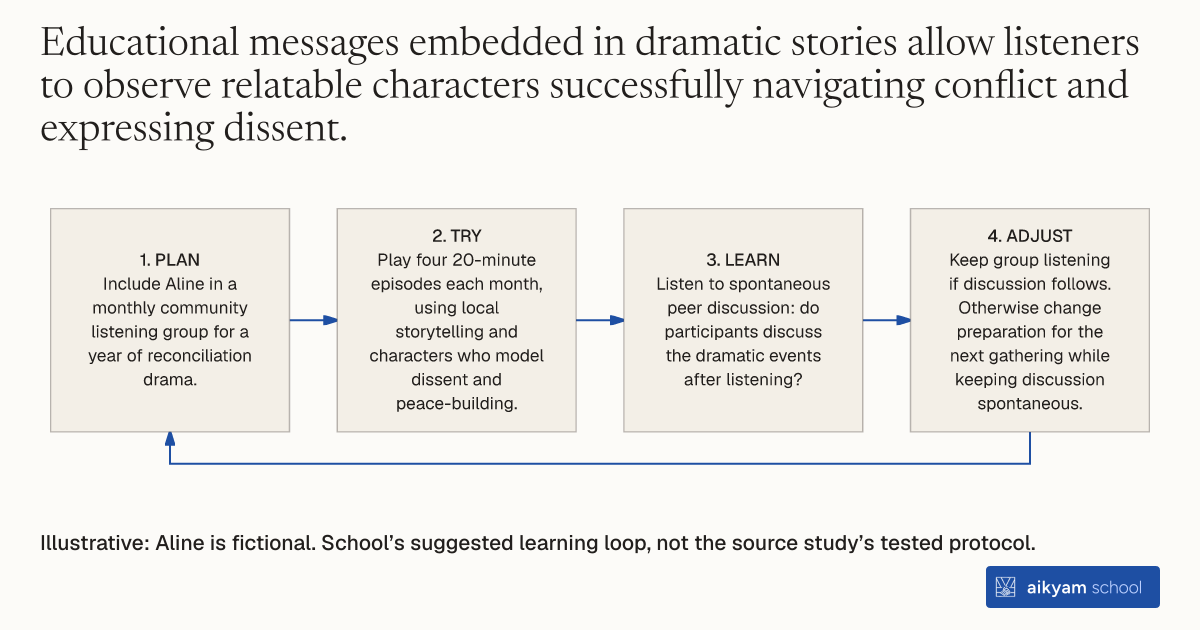
Try, learn and adjust
Check peer discussion after reconciliation drama
- Plan: Include Aline in a monthly community listening group for a year of reconciliation drama.
- Try: Play four 20-minute episodes each month, using local storytelling and characters who model dissent and peace-building.
- Learn: Listen to spontaneous peer discussion: do participants discuss the dramatic events after listening?
- Adjust: Keep group listening if discussion follows. Otherwise change preparation for the next gathering while keeping discussion spontaneous.
Illustrative: Aline is fictional. School’s suggested learning loop, not the source study’s tested protocol.
See source →Observe spontaneous discussion after episodes. School’s loop does not establish the drama’s effects on social norms. School’s suggested learning loop; not a tested source procedure.
How
When to use
Post-conflict societies often struggle with entrenched habits of obedience and deep mistrust between opposing groups. Standard policy directives or legal changes rarely alter everyday political conduct and public deference in the short term. Mass media interventions help post-conflict communities by expanding available behavioral choices and encouraging local collective action.
Broadcast a dramatic fictional radio soap opera that enfolds social reconciliation themes into engaging storytelling for community listening groups.
- Hire local scriptwriters to write 20-minute radio episodes using traditional storytelling styles and allegorical plots that mirror real social tensions.
- Model positive political behaviors through archetypal characters who express dissent against bad leaders and build coalitions for peace.
- Broadcast four 20-minute episodes every month over the course of one full year.
- Gather citizens into monthly group listening sessions in local community spaces to listen together on a portable stereo.
- Encourage listeners to discuss the dramatic events spontaneously with peers after each broadcast ends.
Why it works
Listening together in groups triggers peer discussions that reshape perceived social norms about acceptable public conduct.
Example
Researchers tested the reconciliation soap opera Musekeweya with 556 rural participants across 14 community clusters in post-genocide Rwanda over one year. The program featured a drama about two neighboring communities where young heroes formed a peace coalition against power-hungry leaders.
About the study
Participants
556 participants across 14 community clusters in Rwanda (50% male, mean age 38.9 years), including genocide survivors, Twa minority members, prisoners, and general population villages.
Study Design
Cluster-randomized controlled field trial over one year comparing pairs of communities listening to the reconciliation soap opera Musekeweya against control communities listening to an HIV health drama.
Results
Reconciliation listeners showed a statistically significant increase in willingness to express dissent (0.26 to 0.29 probit shift, p < 0.001), publicly admitted community mistrust in focus groups (fewer than 20% denials vs over 60% in control, p < 0.01), and offered significantly more dissenting opinions during real-world resource negotiations (z = 2.64, p < 0.01).