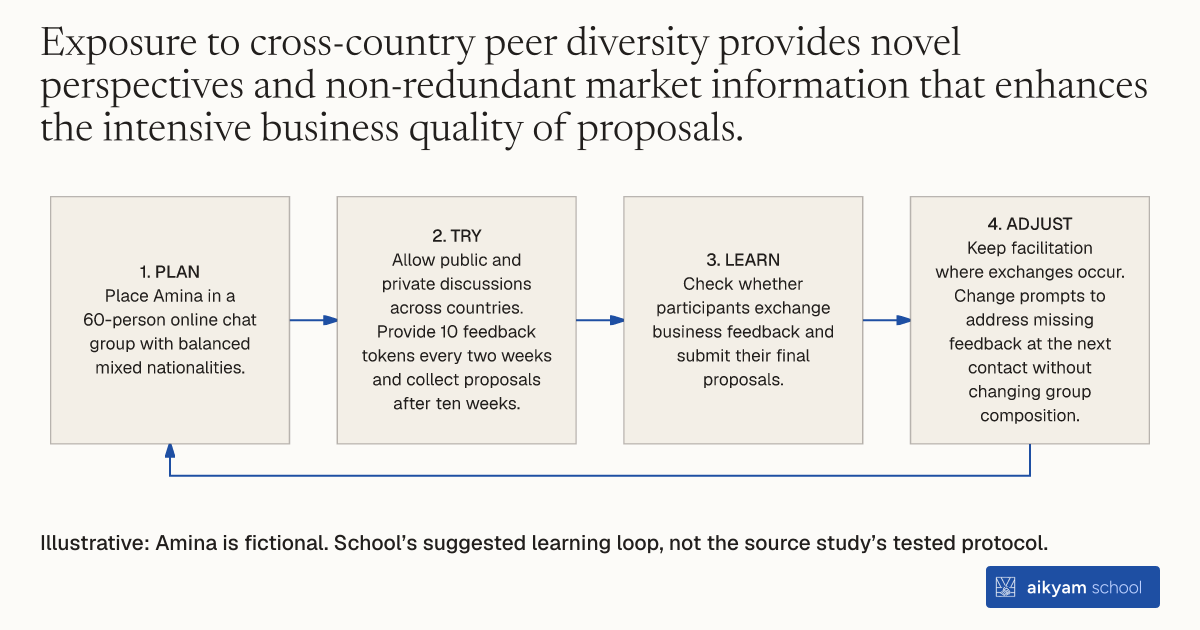
Try, learn and adjust
Check cross-country groups exchange feedback
- Plan: Place Amina in a 60-person online chat group with balanced mixed nationalities.
- Try: Allow public and private discussions across countries. Provide 10 feedback tokens every two weeks and collect proposals after ten weeks.
- Learn: Check whether participants exchange business feedback and submit their final proposals.
- Adjust: Keep facilitation where exchanges occur. Change prompts to address missing feedback at the next contact without changing group composition.
Illustrative: Amina is fictional. School’s suggested learning loop, not the source study’s tested protocol.
See source →School’s suggested, untested loop: observe cross-border feedback and submissions; peer-effect estimates do not establish an overall treatment effect.
How
When to use
Organizations need to foster novel idea generation and business quality among entrepreneurs across multiple regions using digital platforms. Geographic separation limits cross-border collaboration, while homogeneous local networks may reduce exposure to novel market insights. Connecting entrepreneurs in nationally diverse online chat groups enables cross-border feedback and idea recombination.
Connect entrepreneurs from diverse countries in nationally heterogeneous online chat groups to share cross-border feedback and evaluate business ideas.
- Partition participants into virtual chat groups of 60 members composed of balanced mixed nationalities across represented countries.
- Provide a customized open-source internet chatting platform where participants create public or private discussion channels.
- Allow entrepreneurs to establish bilateral or multilateral messaging threads across national borders.
- Issue 10 digital tokens to each participant every two weeks to award to peers who offer valuable feedback on business plans.
- Collect final online business proposals from participants at the end of ten weeks.
Why it works
However, the lack of national familiarity or common social norms can reduce initial participation and proposal submission rates among entrepreneurs from large domestic markets.
Example
Program managers assigned 1,057 entrepreneurs from 44 small African countries and 1,111 entrepreneurs from 5 large African countries to nationally heterogeneous virtual chat groups of 60 members over ten weeks. Among small-country entrepreneurs, virtual-across networking generated significant positive network peer effects on intensive proposal quality (\\(\beta = 0.476, p < 0.01\\)) and extensive quality (\\(\beta = 0.537, p < 0.01\\)), though overall proposal submission fell from 42% in control to 36.3% in treated groups.
About the study
Participants
1,057 entrepreneurs in Small-Country Sample (44 countries) and 1,111 in Large-Country Sample (5 countries) assigned to virtual-across treatment; 31% female, 82% university educated, 63% with existing businesses.
Study Design
Randomized controlled trial comparing virtual-across chat networking against virtual-within chat networking and pure course control groups over a 10-week intervention.
Results
In small countries, virtual-across interaction produced significant positive network peer effects on intensive quality (\\(\beta = 0.476, p < 0.01\\)) and extensive quality (\\(\beta = 0.537, p < 0.01\\)), but no significant effect on submission (\\(\beta = 0.098, p > 0.10\\)). In large countries, virtual-across interaction yielded no statistically significant treatment or peer effects across submission (\\(\beta = 0.014\\)), extensive quality (\\(\beta = 0.060\\)), or intensive quality (\\(\beta = 0.087\\)).