Try, learn and adjust
Check attendance and interest at listening sessions
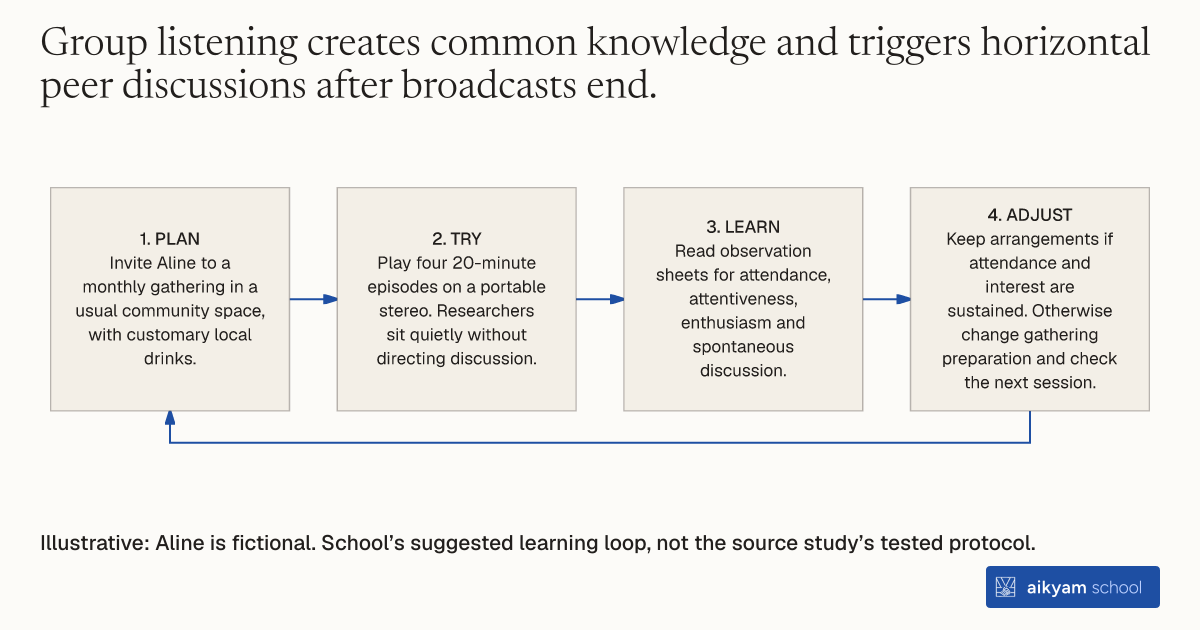
- Plan: Invite Aline to a monthly gathering in a usual community space, with customary local drinks.
- Try: Play four 20-minute episodes on a portable stereo. Researchers sit quietly without directing discussion.
- Learn: Read observation sheets for attendance, attentiveness, enthusiasm and spontaneous discussion.
- Adjust: Keep arrangements if attendance and interest are sustained. Otherwise change gathering preparation and check the next session.
Illustrative: Aline is fictional. School’s suggested learning loop, not the source study’s tested protocol.
See source →Observe attendance, attentiveness, enthusiasm and discussion. Do not treat these checks as proof of changed norms. School’s suggested learning loop; not a tested source procedure.
How
When to use
In low-income or post-conflict settings where personal radio ownership is limited, delivering media interventions through organized public broadcasts ensures reliable participation. Gathering community members to listen together turns media exposure into a shared social experience for rural populations.
Organize monthly communal radio listening sessions for sampled community members using portable stereos in local public spaces.
- Convene participants in local community spaces where citizens normally gather.
- Provide customary local drinks to establish a relaxed and welcoming atmosphere.
- Play four 20-minute radio soap opera episodes every month on a portable stereo cassette player.
- Require research team members to sit quietly with the group during broadcasts without guiding discussion.
- Record attendance, attentiveness, enthusiasm, and spontaneous post-broadcast discussions on standardized observation sheets.
Why it works
These spontaneous peer discussions allow community members to negotiate shared understandings of acceptable public conduct.
Example
Across 14 community sites in Rwanda, participants met monthly in community spaces for one year to listen to four 20-minute radio drama episodes on a portable stereo, maintaining high attendance and spending most post-program time discussing the broadcast.
About the study
Participants
556 participants across 14 community clusters in Rwanda (50% male, average age 38.9 years), with an average site attendance of 35.6 participants per monthly session.
Study Design
Group-randomized field experiment where research assistants conducted monthly visits over one year, broadcasting 4 episodes per visit on portable stereos and rating group attentiveness, enthusiasm, and discussions on 1 to 5 scales.
Results
Monthly attendance averaged 35.6 participants per site, with high program interest ratings (4.0 to 4.2 out of 5) and enthusiasm (3.3 to 3.6 out of 5), while participants spent 63% of post-broadcast time spontaneously discussing the program.