Try, learn and adjust
Check tokens reach helpful peers
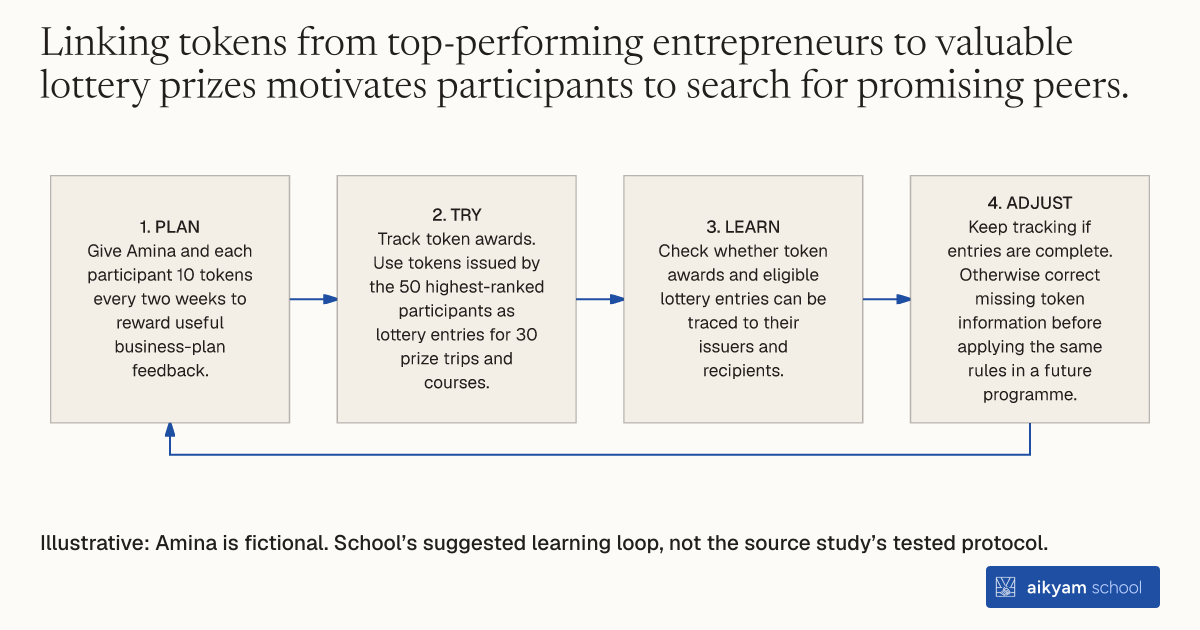
- Plan: Give Amina and each participant 10 tokens every two weeks to reward useful business-plan feedback.
- Try: Track token awards. Use tokens issued by the 50 highest-ranked participants as lottery entries for 30 prize trips and courses.
- Learn: Check whether token awards and eligible lottery entries can be traced to their issuers and recipients.
- Adjust: Keep tracking if entries are complete. Otherwise correct missing token information before applying the same rules in a future programme.
Illustrative: Amina is fictional. School’s suggested learning loop, not the source study’s tested protocol.
See source →School’s suggested, untested loop: observe token distribution, awards and lottery eligibility without changing prize or ranking rules.
How
When to use
Organizations need to motivate participants to give helpful advice and feedback to peers in online networks. Participants often lack natural incentives to spend time reviewing work submitted by other members. Distributing peer-reward tokens creates a game-like incentive system that encourages continuous peer engagement.
Distribute digital tokens to participants to award to helpful peers for feedback throughout a training program.
- Provide 10 tokens to each participant every two weeks during the program.
- Instruct participants to hand tokens to peers who provide helpful advice and feedback on business plans.
- Track the baseline performance grades of all participants at the end of the intervention.
- Collect all tokens issued by the 50 highest-ranked participants across the program.
- Use collected tokens as lottery tickets to award 30 prize trips and training courses to recipient peers.
Why it works
This structure encourages participants to offer high-quality feedback to attract and retain strong business partners.
Example
Program coordinators distributed 10 bi-weekly tokens to 4660 treated entrepreneurs across 49 African countries over ten weeks. Tokens issued by the 50 top-ranked entrepreneurs served as lottery tickets for 30 Bocconi Prizes involving a fully covered two-week trip to Milan.
About the study
Participants
4660 treated entrepreneurs across 49 African countries; 31% female, average age 30.96 years, 82% completed university.
Study Design
Randomized controlled trial embedding a bi-weekly token distribution mechanism across 60-person face-to-face and virtual chat interaction groups during a 10-week intervention.
Results
All treated participants received 10 tokens every two weeks. Tokens from the top 50 evaluation-ranked entrepreneurs served as raffle entries for 30 Bocconi Prize trips to Milan, stimulating active peer communication and bilateral feedback.