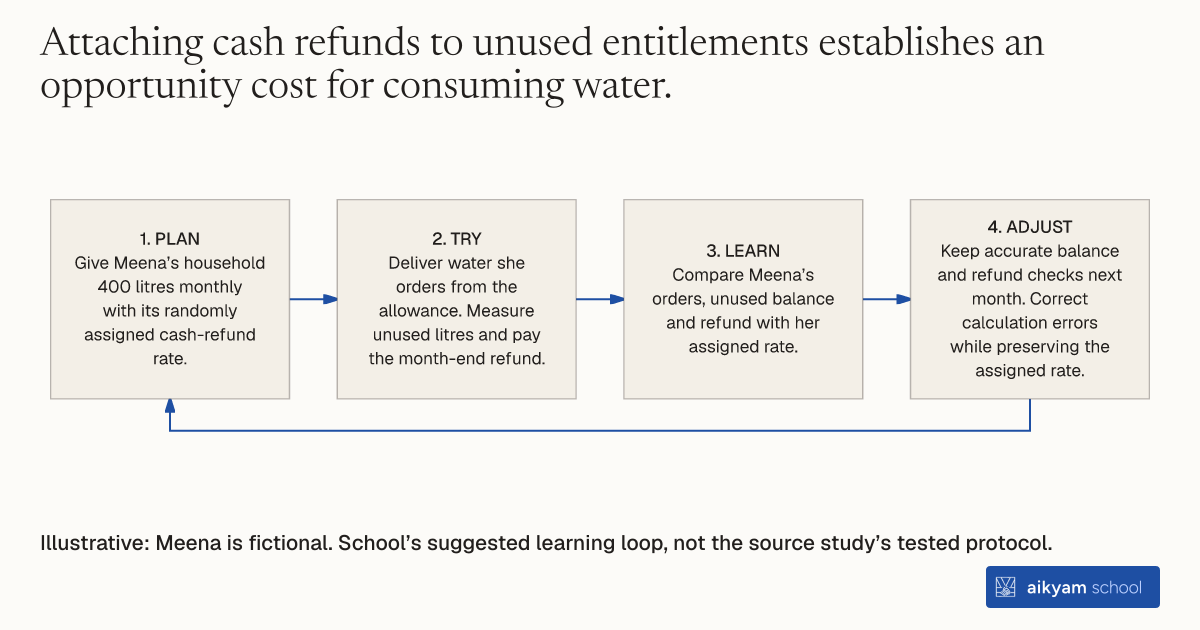
Try, learn and adjust
Check water balances and cash refunds
- Plan: Give Meena’s household 400 litres monthly with its randomly assigned cash-refund rate.
- Try: Deliver water she orders from the allowance. Measure unused litres and pay the month-end refund.
- Learn: Compare Meena’s orders, unused balance and refund with her assigned rate.
- Adjust: Keep accurate balance and refund checks next month. Correct calculation errors while preserving the assigned rate.
Illustrative: Meena is fictional. School’s suggested learning loop, not the source study’s tested protocol.
See source →School’s suggested, untested loop. Observe ordered water, unused litres and month-end cash refunds; no individual health benefit is assumed.
How
When to use
Rural households in low-income settings need uncontaminated drinking water but face strict financial constraints. Free distribution without financial trade-offs does not reveal how much families value clean water compared to money. Providing exchangeable entitlements allows households to choose between ordering clean water or receiving cash for unused water.
Grant households a monthly free water entitlement while offering cash refunds for any unclaimed portion at the end of each month.
- Spring Health provides selected households with an entitlement of 400 liters of free water per month.
- Field staff randomly assign each household's cash refund rate equal to one of the prices paid in the priced water group.
- Households place orders with Spring Health to draw from their 400-liter monthly allowance as needed.
- Staff measure each household's unclaimed water balance at the end of the month.
- Spring Health calculates and disburses cash refunds directly to households for all unclaimed liters.
Why it works
Choosing water over cash reveals that households place a high implicit valuation on drinking clean water at home.
Example
Spring Health assigned 38 selected households in each of 40 villages in rural Odisha, India, a 400-liter monthly entitlement convertible to cash. Households increased their clean water consumption by 291 liters per month, choosing to forego an average of INR 420 per month in cash refunds to keep clean drinking water.
About the study
Participants
40 villages comprising 15,000 households in rural Odisha, India, with an average household size of five members and median bank balance of INR 2,000.
Study Design
Randomized controlled trial assigning 40 villages to an exchangeable entitlement group, randomizing 38 households per village to receive 400 liters of water per month with cash refunds disbursed at month-end for unused liters.
Results
Households increased clean water consumption by 291 liters per month, forewent INR 420 per month in cash refunds to maintain water access, reduced water collection time by 15 to 39 percent, and missed 36 percent fewer workdays among active drinkers.