Research steps
Track demand after a free water sample
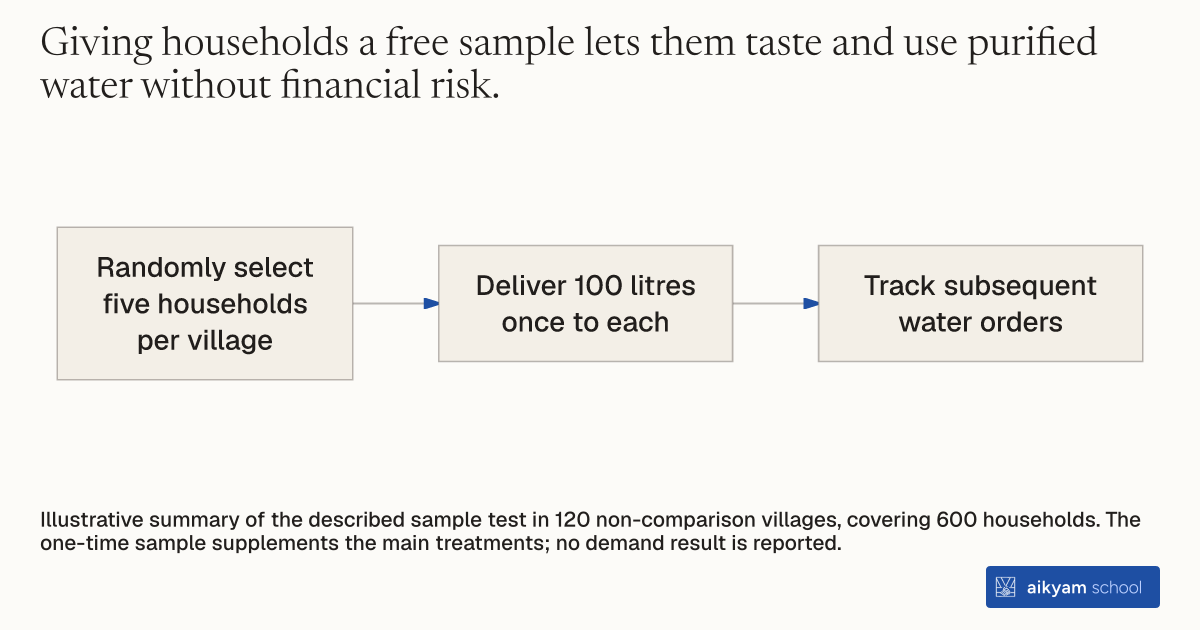
- Randomly select five households per village
- Deliver 100 litres once to each
- Track subsequent water orders
Illustrative summary of the described sample test in 120 non-comparison villages, covering 600 households. The one-time sample supplements the main treatments; no demand result is reported.
See source →How
When to use
Rural households in low-income regions often hesitate to pay for purified water due to uncertainty about its taste or quality. Unpleasant tastes from alternatives like chlorine drops make families cautious about new water sources. Distributing a one-time free sample ration lets households test clean water at home before buying.
Distribute a single trial ration of purified drinking water to selected households to evaluate whether experience drives water demand.
- Spring Health selects target households across intervention villages receiving clean water services.
- Field staff randomly assign five households per non-comparison village to receive a free sample.
- Delivery workers deliver 100 liters of purified water directly to each selected household doorway.
- Staff track subsequent household order volumes to measure the impact of initial water experience.
Why it works
Experiencing doorstep water delivery firsthand reduces doubt and encourages households to purchase water later.
Example
Spring Health provided a one-time free ration of 100 liters of water to five households in each non-comparison village across rural Odisha, India, to test if sampling affected future purchases.
About the study
Participants
600 households in 120 non-comparison villages in rural Odisha, India, where 26 percent of rural families lack safe water access.
Study Design
Randomized controlled trial selecting five households per non-comparison village to receive a 100-liter free trial water ration alongside the main pricing and entitlement treatments.
Results
Tested whether providing 100 liters of clean water as an initial free sample changed future ordering behavior among rural households.