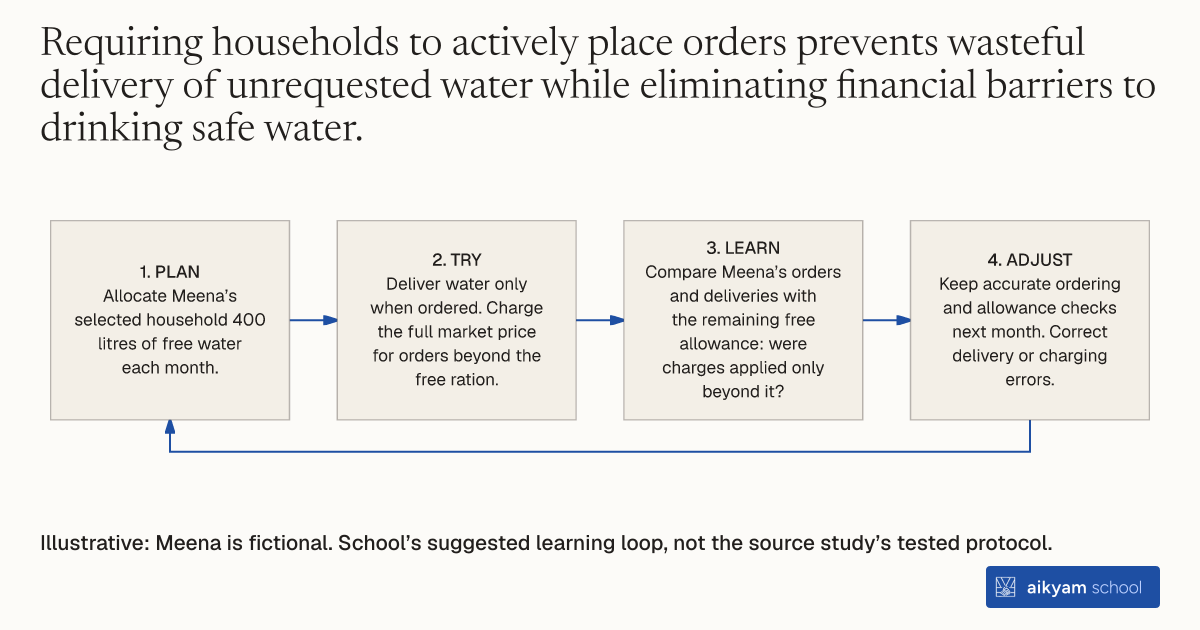
Try, learn and adjust
Check requested water deliveries
- Plan: Allocate Meena’s selected household 400 litres of free water each month.
- Try: Deliver water only when ordered. Charge the full market price for orders beyond the free ration.
- Learn: Compare Meena’s orders and deliveries with the remaining free allowance: were charges applied only beyond it?
- Adjust: Keep accurate ordering and allowance checks next month. Correct delivery or charging errors.
Illustrative: Meena is fictional. School’s suggested learning loop, not the source study’s tested protocol.
See source →School’s suggested, untested loop. Observe opt-in orders, delivery and allowance use; no individual health benefit is assumed.
How
When to use
Rural households in low-income settings lack access to uncontaminated drinking water due to high poverty and collection burdens. Providing free water rations removes financial barriers, but unrequested distribution leads to waste. Opt-in ordering ensures free water reaches families who choose to consume clean drinking water.
Provide households with a monthly quota of free purified drinking water that requires explicit opt-in ordering to receive delivery.
- Spring Health assigns a monthly ration of 400 liters of free purified water to eligible selected households.
- Selected households place an order with Spring Health whenever they wish to receive a delivery from their free ration.
- Delivery personnel transport the ordered water directly to the household doorway.
- Staff allow households who exhaust their 400-liter ration to order additional water at the full market price.
- Unselected households in the village order water at the full market price.
Why it works
Allowing households to buy additional water at market price supports families whose monthly needs exceed the free allowance.
Example
Spring Health assigned a free monthly ration of 400 liters to 39 selected households in each of 40 villages in Odisha, India. The ordering likelihood reached 90 percent, with households increasing water consumption by an average of 270 liters per month.
About the study
Participants
40 villages comprising 15,000 households in rural Odisha, India, with an average household size of five and median bank balance of INR 2,000.
Study Design
Randomized controlled trial assigning 40 villages to a free water ration intervention, randomizing 39 households per village to receive 400 liters per month via opt-in ordering.
Results
Selected households achieved a 90 percent order likelihood and increased water consumption by an average of 270 liters per month, while reducing water collection time by 15 to 39 percent.