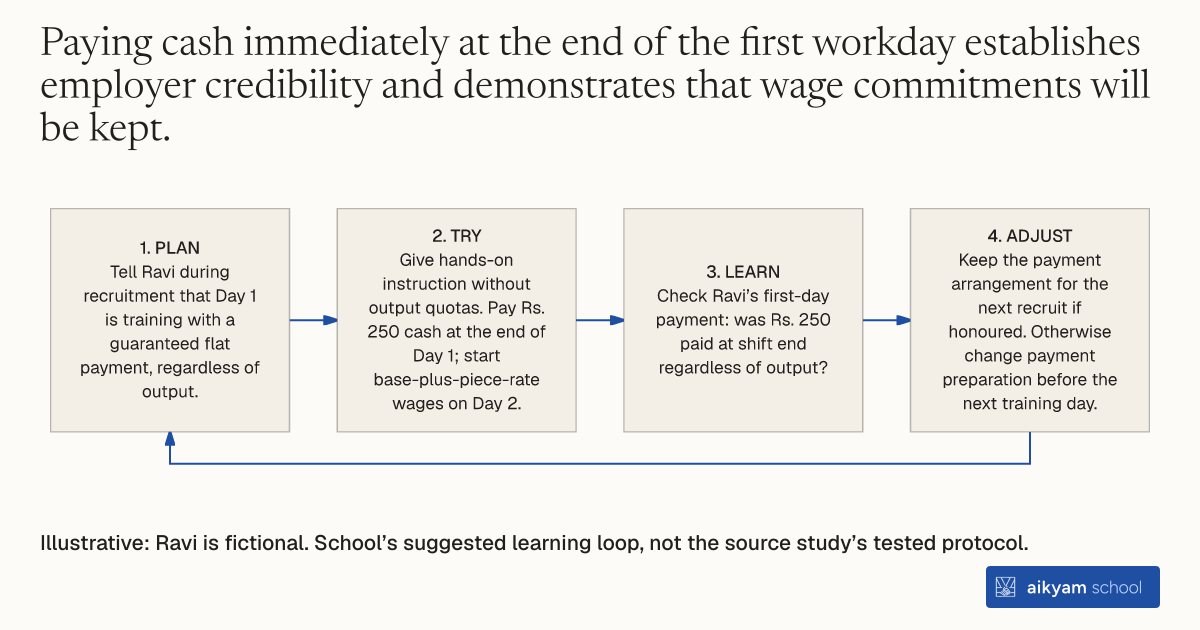
Try, learn and adjust
Check the promised first-day training wage
- Plan: Tell Ravi during recruitment that Day 1 is training with a guaranteed flat payment, regardless of output.
- Try: Give hands-on instruction without output quotas. Pay Rs. 250 cash at the end of Day 1; start base-plus-piece-rate wages on Day 2.
- Learn: Check Ravi’s first-day payment: was Rs. 250 paid at shift end regardless of output?
- Adjust: Keep the payment arrangement for the next recruit if honoured. Otherwise change payment preparation before the next training day.
Illustrative: Ravi is fictional. School’s suggested learning loop, not the source study’s tested protocol.
See source →School’s suggested, untested loop: observe the promised amount and timing; do not treat payment as proof of trust or retention.
How
When to use
Introduce new casual wage laborers to a novel manufacturing facility or workplace task. It addresses worker skepticism and lack of trust in unfamiliar employers regarding whether promises of future wages will be honored. It serves project managers, contractors, and field experimenters hiring rural contract workers.
Foster early workplace trust and task orientation by paying a guaranteed flat wage on the first day of employment regardless of initial output.
- Inform newly recruited casual laborers during village recruitment that their first day will serve as an orientation and training day.
- Assure workers that they will receive a guaranteed flat cash payment at the end of Day 1 upon completing their first shift.
- Provide hands-on task instruction and allow workers to practice manufacturing skills on Day 1 without output quotas or piece-rate performance penalties.
- Disburse the flat training wage of Rs. 250 in cash directly to each worker at the end of the Day 1 shift as promised.
- Transition workers on Day 2 to the standard contract wage structure combining a base wage with piece-rate performance incentives.
Why it works
Removing piece-rate pressure on Day 1 lets workers master complex fine motor tasks without worrying about initial low earnings.
Example
At manufacturing worksites in rural Odisha, India, 408 casual piece-rate workers received a flat training wage of Rs. 250 at the end of Day 1. This immediate disbursement established employer trust across 14 experimental rounds, contributing to a 98.3% daily attendance rate and a 98.5% contract completion rate.
About the study
Participants
408 male casual wage laborers aged 18 to 55 across 14 experimental rounds in Odisha, India.
Study Design
Guaranteed flat wage payment of Rs. 250 disbursed at the end of Day 1 across all experimental rounds prior to implementing piece-rate incentive structures.
Results
Delivering immediate Day 1 training pay built workplace credibility, helping achieve a 98.3% daily attendance rate and limiting contract attrition to just 6 total dropouts out of 408 enrolled workers.