Try, learn and adjust
Check frequent caseworker reviews
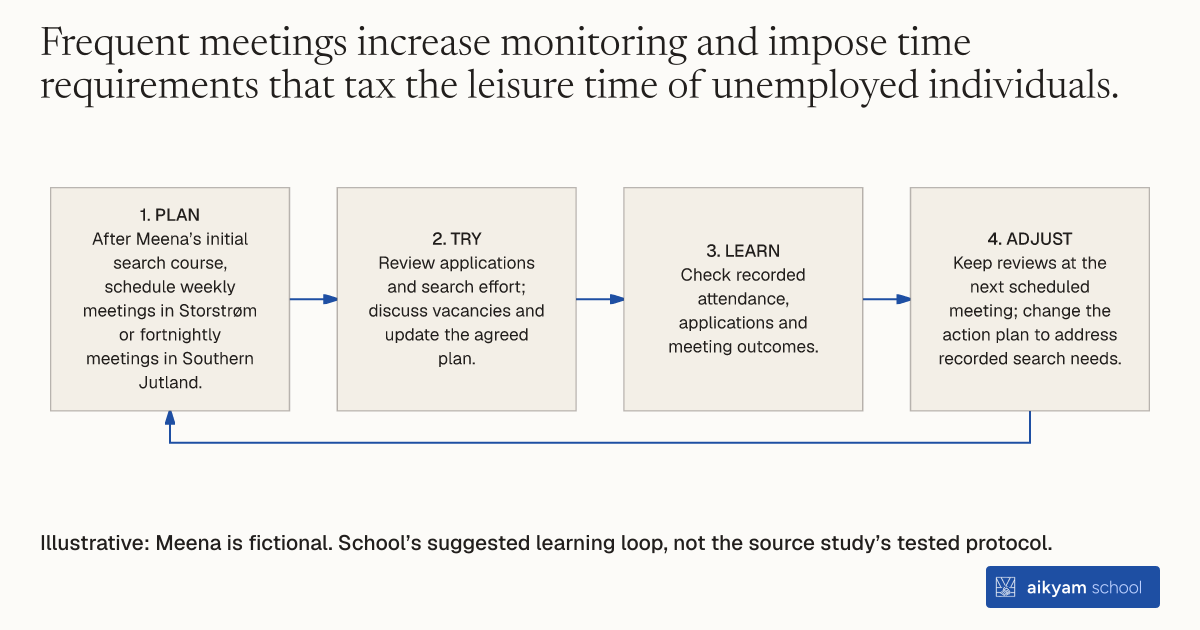
- Plan: After Meena’s initial search course, schedule weekly meetings in Storstrøm or fortnightly meetings in Southern Jutland.
- Try: Review applications and search effort; discuss vacancies and update the agreed plan.
- Learn: Check recorded attendance, applications and meeting outcomes.
- Adjust: Keep reviews at the next scheduled meeting; change the action plan to address recorded search needs.
Illustrative: Meena is fictional. School’s suggested learning loop, not the source study’s tested protocol.
See source →School’s suggested, untested loop. Observe scheduled and attended meetings, applications and action plans; meeting attendance alone does not establish employment effects.
How
When to use
Unemployed benefit recipients often face reduced incentives to search for work during prolonged unemployment. Conducting frequent face-to-face meetings with caseworkers maintains job-search momentum and monitors application activity. Public employment agencies use this method to supervise insured job seekers continuously throughout their unemployment spell.
Schedule and conduct highly frequent face-to-face contact meetings between unemployed workers and employment caseworkers to review job search strategies.
- Assign unemployed individuals who complete initial job search courses to a caseworker meeting schedule.
- Convene individual contact meetings every week in Storstrøm or every fortnight in Southern Jutland throughout the unemployment spell.
- Review job applications submitted and active search efforts made by the unemployed worker during each session.
- Discuss labor market opportunities, refine job search strategies, and update agreed action plans.
- Record attendance and meeting outcomes in central employment register databases.
Why it works
This persistent oversight elevates the perceived risk of future administrative requirements, motivating workers to intensify job searches or lower reservation wages.
Example
Public job centers in Storstrøm and Southern Jutland mandated weekly and biweekly caseworker meetings for treated unemployed workers in 2005–2006. In Storstrøm, meeting intensity reached approximately 40% weekly (an average meeting every 2.5 weeks), whereas Southern Jutland achieved approximately 30% weekly (every 3 weeks), compared to quarterly meetings for control groups.
About the study
Participants
N = 4,513 unemployed individuals across Storstrøm and Southern Jutland counties, Denmark.
Study Design
Randomized controlled trial assigning job seekers by birth date (1st–15th = treatment, 16th–31st = control) evaluated using mixed proportional hazard models with time-varying meeting indicators.
Results
Higher estimated meeting intensity had a statistically significant positive effect on unemployment exit rates (coefficients of 0.47 in Storstrøm and 2.30 in Southern Jutland), whereas actual meeting attendance in a given week showed no direct positive effect, confirming that meeting threat and monitoring risks drove job findings.