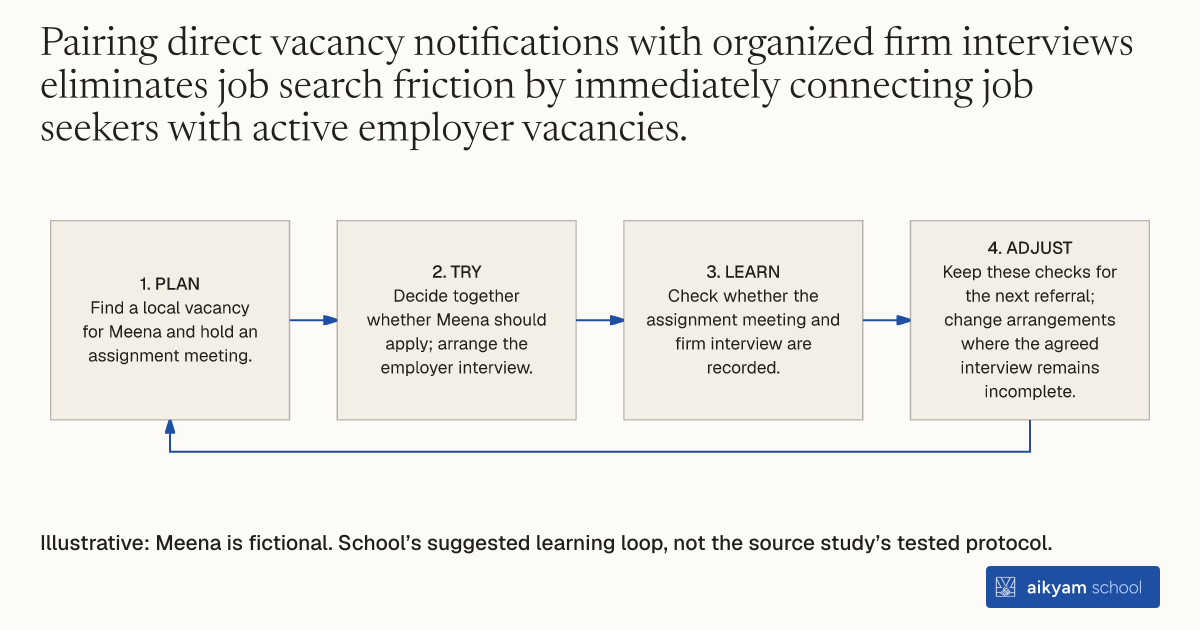
Try, learn and adjust
Check vacancy referrals and interviews
- Plan: Find a local vacancy for Meena and hold an assignment meeting.
- Try: Decide together whether Meena should apply; arrange the employer interview.
- Learn: Check whether the assignment meeting and firm interview are recorded.
- Adjust: Keep these checks for the next referral; change arrangements where the agreed interview remains incomplete.
Illustrative: Meena is fictional. School’s suggested learning loop, not the source study’s tested protocol.
See source →School’s suggested, untested loop. Observe assignment meetings, applications and firm interviews; no job offer is assumed.
How
When to use
Unemployed job seekers often do not discover specific local job vacancies or lack direct introductions to hiring employers. Conducting sequential job assignment meetings and firm interviews addresses this matching gap by directly connecting job seekers to open vacancies. Public employment agencies use this method for insured unemployed workers.
Match unemployed workers directly to open firm vacancies through paired caseworker assignment meetings and employer job interviews.
- Case workers identify open job vacancies listed by local hiring firms.
- Case workers convene a job assignment meeting with the unemployed worker to present the open position.
- Case worker and worker evaluate the position and decide whether the worker should submit a formal application.
- Organize a job interview at the hiring firm for the worker to meet the potential employer.
- Register the job assignment meeting and firm interview events in central public employment administrative databases.
Example
Public job centers in Storstrøm and Southern Jutland organized job assignment meetings and firm interviews during 2005 and 2006. In Storstrøm, attending a job assignment meeting within the preceding two weeks produced an exit rate hazard coefficient of 0.27 for treatment workers, while attending a job interview produced a coefficient of 0.59.
About the study
Participants
N = 4,513 unemployed workers across Storstrøm and Southern Jutland counties, Denmark.
Study Design
Randomized controlled trial assigning workers by birth date (1st–15th = treatment, 16th–31st = control) evaluated using mixed proportional hazard duration models.
Results
Recent attendance at a job assignment meeting yielded exit hazard coefficients of 0.27 (treatment) and 0.27 (control) in Storstrøm, and 0.18 (treatment) and 0.49 (control) in Southern Jutland, while job interviews yielded exit hazard coefficients of 0.59 (treatment) and 0.34 (control) in Storstrøm.