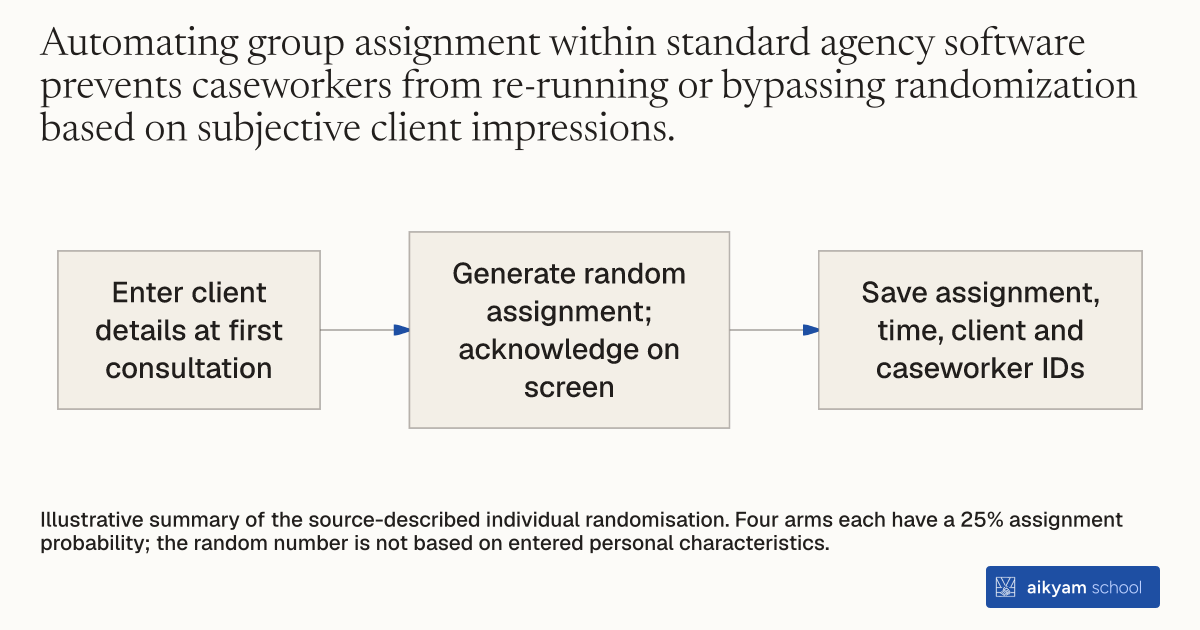
Research steps
Assign clients through intake software
- Enter client details at first consultation
- Generate random assignment; acknowledge on screen
- Save assignment, time, client and caseworker IDs
Illustrative summary of the source-described individual randomisation. Four arms each have a 25% assignment probability; the random number is not based on entered personal characteristics.
See source →How
When to use
Caseworkers conducting intake consultations with unemployed job seekers may intentionally or unintentionally alter treatment assignment. Standard manual assignment risks introducing selection bias into field trials of active labor market policies. An automated software pop-up tool randomizes treatment status at the individual level during client intake without allowing caseworker manipulation.
Integrate an automated randomization tool into employment agency computer systems to assign new job seekers to experimental treatment arms during initial intake meetings.
- Open the specialized evaluation software tool during the first consultation meeting with a newly registered unemployed client.
- Enter the job seeker's identification number, full name, and date of birth into the software interface.
- Trigger the automated random number generator within the system to produce an unmanipulable group assignment.
- View the generated treatment status displayed immediately on the screen and acknowledge it in the placement software.
- Record the time, randomized assignment outcome, client identifier, and caseworker identifier in the agency database.
Why it works
This ensures that baseline characteristics remain balanced across experimental treatment groups.
Example
Across five regional labor agencies in Germany, caseworkers used a specialized computer app to assign 4,163 male job seekers to four integration agreement treatment arms with equal 25% probabilities. Baseline balancing tests confirmed equal distributions across groups, yielding a multinomial logit p-value of 0.42.
About the study
Participants
4,163 male unemployment insurance benefit recipients aged 25 to 64 across 213 caseworkers in five regional German employment agencies.
Study Design
Automated individual-level randomization triggered during caseworker intake meetings, evaluated via multinomial logit likelihood ratio balancing tests on baseline demographics and labor histories.
Results
Equal 25% assignment across 4 treatment arms yielded well-balanced baseline characteristics, with joint test p-values ranging from 0.16 to 0.98 across individual covariates and an overall multinomial logit balancing p-value of 0.42.