Research procedure
Value averted arrests by offence type
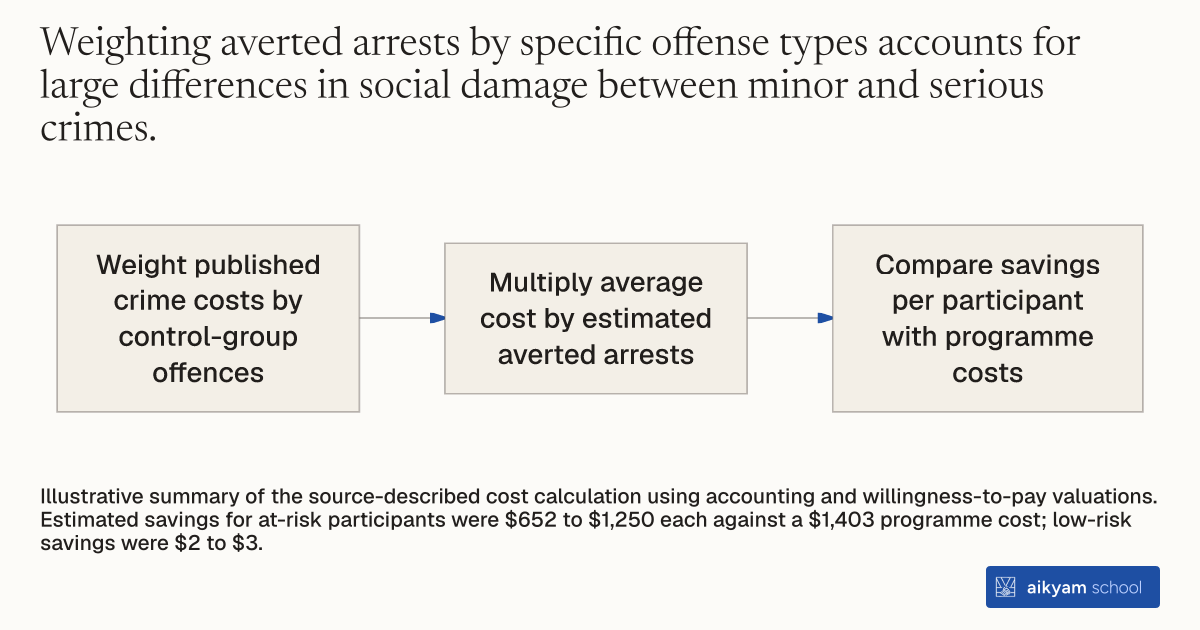
- Weight published crime costs by control-group offences
- Multiply average cost by estimated averted arrests
- Compare savings per participant with programme costs
Illustrative summary of the source-described cost calculation using accounting and willingness-to-pay valuations. Estimated savings for at-risk participants were $652 to $1,250 each against a $1,403 programme cost; low-risk savings were $2 to $3.
See source →How
When to use
Evaluating public employment programs requires measuring their economic return to justify taxpayer funding. Monetizing averted crimes translates reductions in arrests into concrete dollar figures. This method serves policy analysts conducting cost-benefit evaluations of social intervention programs.
Calculate social crime prevention savings by weighting averted arrests by offense-specific monetized cost estimates.
- Obtain baseline offense distribution frequencies from control group arrest records during the program window.
- Select published per-offense social cost estimates using bottom-up accounting or willingness-to-pay valuation models.
- Compute an offense-weighted average social cost per arrest based on the control group offense distribution.
- Multiply the estimated number of averted arrests per participant by the offense-weighted average social cost.
- Compare total monetized crime prevention savings per participant against average program delivery costs.
Why it works
Calculating monetized external savings provides policy makers with direct cost-offset figures for targeted public investments.
Example
Researchers evaluated crime prevention savings for 163,447 New York City summer job applicants between 2005 and 2008. Using Cohen and Piquero (2009) crime valuations, the average program arrest had a social cost of \$19,000 under bottom-up accounting and \$37,000 under willingness-to-pay models. Preventing 34 arrests per 1,000 at-risk participants generated \$652 to \$1,250 in savings per participant, offsetting 46.5 percent to 89.4 percent of the \$1,403 program cost.
About the study
Participants
163,447 youth applicants (5,092 at-risk youth with prior arrests and 158,355 low-risk youth), New York City.
Study Design
Offense-weighted monetized cost calculation applying bottom-up and willingness-to-pay crime cost valuations to 2SLS treatment effect estimates.
Results
Averted arrests generated \$652 to \$1,250 in social savings per at-risk participant, offsetting 46.5 to 89.4 percent of the \$1,403 average program cost. For low-risk participants, crime reduction benefits totaled \$2 to \$3 per participant.