Research modelling
Estimate health value of less burning
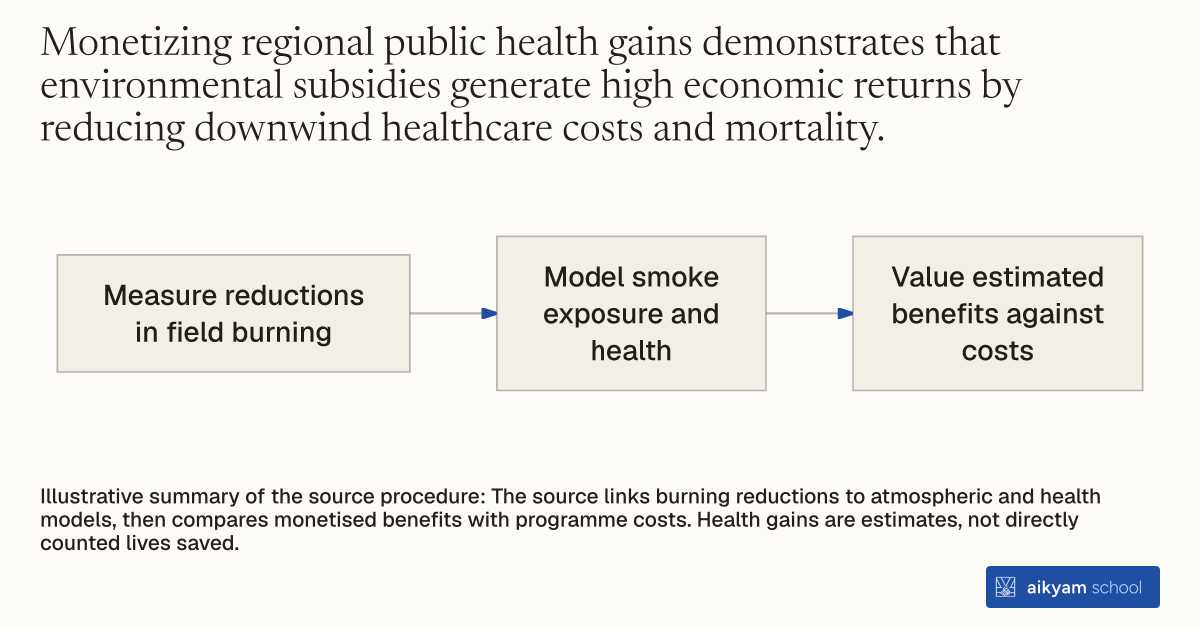
- Measure reductions in field burning
- Model smoke exposure and health
- Value estimated benefits against costs
Illustrative summary of the source procedure: The source links burning reductions to atmospheric and health models, then compares monetised benefits with programme costs. Health gains are estimates, not directly counted lives saved.
See source →How
When to use
Policymakers need to quantify the economic value of agricultural pollution abatement programs relative to public health impacts. Direct environmental subsidy costs often seem high unless balanced against regional health improvements and averted mortality. This evaluation method quantifies downstream public health benefits and cost-per-life-saved metrics generated by burning reduction interventions.
Quantify the net public health benefits of environmental incentive programs by modeling regional health outcomes against intervention costs.
- Measure field-level pollution reductions achieved by environmental payment interventions across target agricultural regions.
- Link observed burning reductions to atmospheric pollution transport models to estimate regional smoke dispersion.
- Calculate averted human health exposure levels in downwind population centers.
- Convert averted pollution exposure into projected reductions in respiratory illness and premature deaths.
- Monetize estimated health improvements using standardized statistical life values.
- Divide total monetized health benefits by full program implementation costs to calculate the return per dollar spent.
Why it works
This evidence justifies public funding for agricultural intervention programs.
Example
In northern India, researchers evaluated the health returns of up-front payments for ecosystem services offered to farmers in Punjab. They calculated that every dollar spent on up-front PES generated 125 to 190 times its cost in regional health benefits from reduced stubble burning, costing \$3,600 to \$5,400 per life saved.
About the study
Participants
Regional population affected by air pollution from 1,668 farmers across 171 villages in Bathinda and Faridkot, Punjab, India.
Study Design
Cost-benefit analysis linking experimental pollution reduction findings from a randomized controlled trial to regional epidemiological and health benefit economic models.
Results
Up-front PES generated \$125 to \$190 in health benefits per dollar spent through reduced stubble burning, achieving an estimated cost of \$3,600 to \$5,400 per life saved.