Research procedure
Elicit hypothetical job preferences
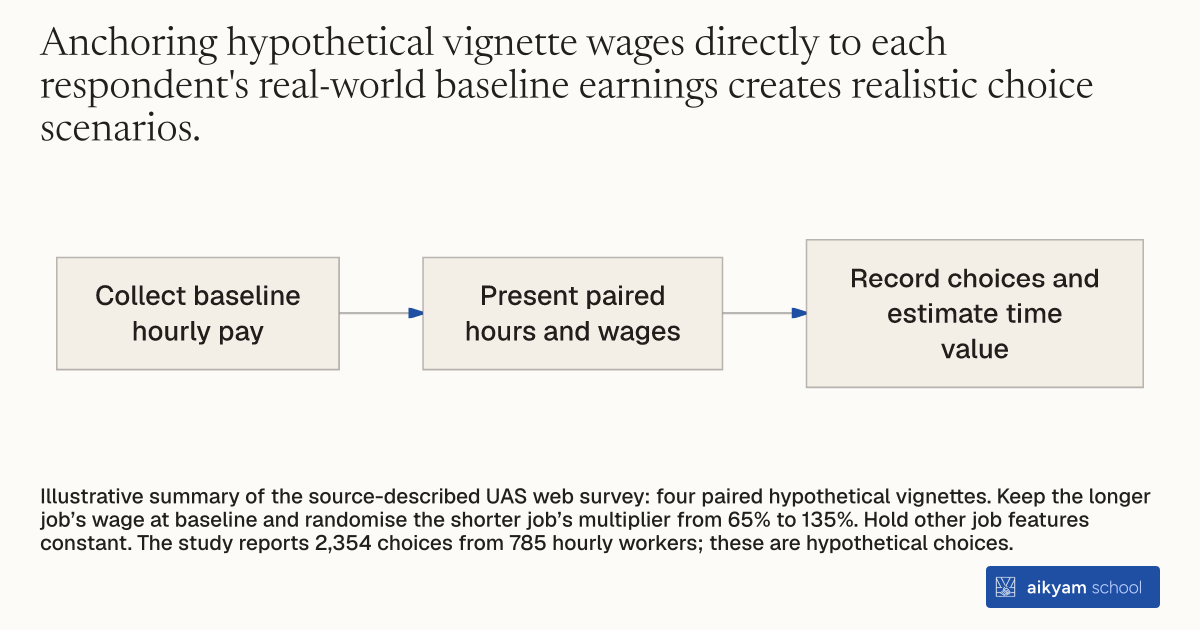
- Collect baseline hourly pay
- Present paired hours and wages
- Record choices and estimate time value
Illustrative summary of the source-described UAS web survey: four paired hypothetical vignettes. Keep the longer job’s wage at baseline and randomise the shorter job’s multiplier from 65% to 135%. Hold other job features constant. The study reports 2,354 choices from 785 hourly workers; these are hypothetical choices.
See source →How
When to use
Researchers need to estimate non-work time valuation across broader, nationally representative worker samples where running real hiring field experiments is unfeasible. Standard survey questions often fail to capture true schedule preferences because unconstrained hypothetical questions yield unrealistic responses. Pairing hypothetical job vignettes with randomized wage multipliers allows analysts to measure stated preferences that closely mirror real-world labor decisions.
Deploy survey-based job vignettes with wage multipliers relative to baseline earnings to measure schedule preferences across representative panel respondents.
- Administer a web survey to a nationally representative panel of hourly workers and collect reported baseline pay rates.
- Present each respondent with a series of four paired hypothetical job vignettes that differ only in weekly work hours and hourly compensation.
- Set the hourly wage of the longer position equal to the respondent's reported baseline hourly pay rate.
- Set the hourly wage of the shorter position by multiplying the baseline pay rate by a randomized multiplier ranging from 65 percent to 135 percent.
- Instruct respondents to choose their preferred position for each vignette under the assumption that non-wage job features match their current or previous job.
- Compute effective incremental wages for the additional work hours and estimate the non-work time flow value using a discrete choice model.
Why it works
This stated preference approach yields time valuation parameters that closely match revealed preference estimates from real field hiring decisions.
Example
Researchers administered web survey vignettes through the Understanding America Study to 785 hourly workers, collecting 2,354 discrete choices across 10, 20, 30, and 40-hour schedule comparisons. Multiplying baseline pay by randomized factors from 65 to 135 percent yielded an estimated non-work flow value relative to pre-tax wages of 0.61.
About the study
Participants
N = 2,354 total choices made by 785 hourly workers in the nationally representative Understanding America Study (UAS) web panel.
Study Design
Web survey choice experiment where panel respondents evaluated four hypothetical job vignettes comparing schedule bundles (10 vs 20, 20 vs 30, 30 vs 40 hours/week) with wages randomized as multipliers (65% to 135%) of reported baseline wages.
Results
The hypothetical choice experiment yielded an estimated flow value of non-work time relative to pre-tax wages of z-tilde = 0.61 (s.e. = 0.03), closely matching the field experiment estimate of 0.58.