Try, learn and adjust
Check latrine support reaches household construction
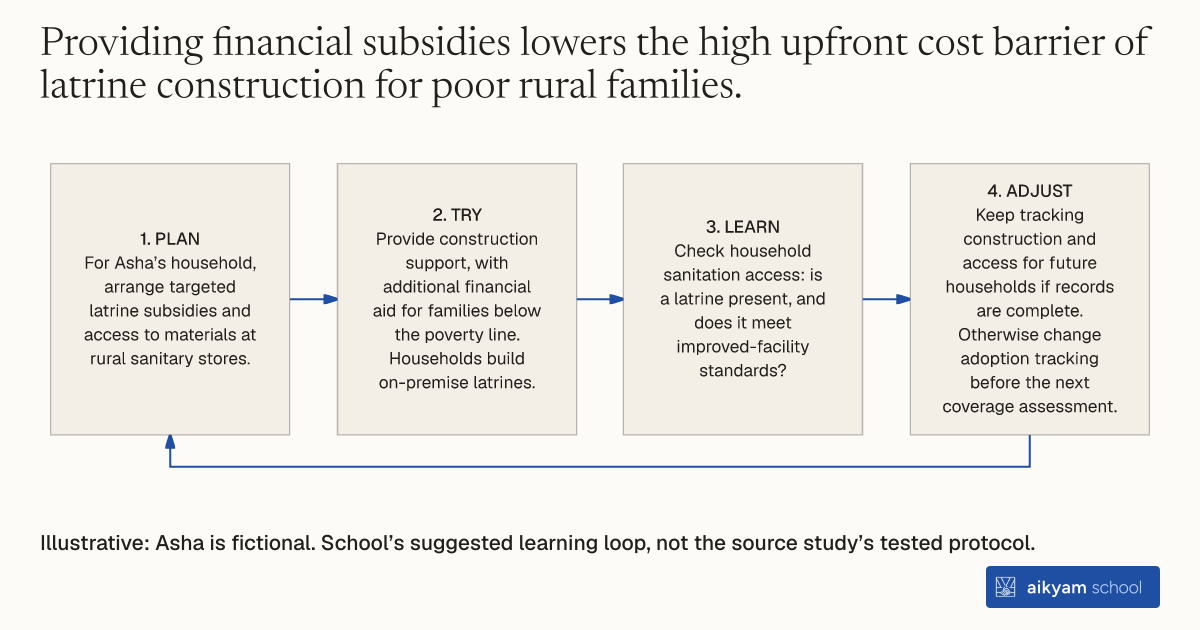
- Plan: For Asha’s household, arrange targeted latrine subsidies and access to materials at rural sanitary stores.
- Try: Provide construction support, with additional financial aid for families below the poverty line. Households build on-premise latrines.
- Learn: Check household sanitation access: is a latrine present, and does it meet improved-facility standards?
- Adjust: Keep tracking construction and access for future households if records are complete. Otherwise change adoption tracking before the next coverage assessment.
Illustrative: Asha is fictional. School’s suggested learning loop, not the source study’s tested protocol.
See source →School’s suggested learning loop, not a source-tested procedure. Observe latrine construction and improved sanitation access; do not attribute the wider campaign’s results to subsidies alone.
How
When to use
Open defecation spreads diarrheal diseases among young children in rural areas. Many poor households lack access to private toilets or cannot afford building materials. This approach provides financial aid and local hardware supply centers to help rural families build home latrines.
Construct individual household latrines by offering targeted financial subsidies and establishing rural supply stores.
- Program managers support rural sanitary stores to provide construction materials for toilets.
- Field staff distribute targeted subsidies to households for individual household latrine construction.
- Local officials deliver additional financial subsidies specifically to families below the poverty line.
- Enrolled households use supplied hardware materials and subsidies to construct on-premise individual latrines.
Why it works
Supporting local sanitary stores ensures that necessary building materials remain accessible within rural communities.
Example
In rural Madhya Pradesh, India, researchers evaluated the Total Sanitation Campaign across 40 treatment villages where subsidies and sanitary store support were deployed to households with children under 24 months of age. The intervention raised the share of households with WHO-compliant improved sanitation facilities to 41.4 percent, compared to 22.4 percent in comparison villages.
About the study
Participants
80 rural villages in Madhya Pradesh, India, focusing on households with children under 24 months of age and the rural population.
Study Design
Randomized evaluation across 80 villages where 40 villages received the Total Sanitation Campaign intervention and 40 villages served as comparison.
Results
The proportion of households with improved sanitation facilities meeting WHO standards increased to 41.4 percent (19 percentage points higher than comparison villages), and daily open defecation decreased by 11 to 12 percent among men and women, though child health outcomes remained unchanged.