Research groups
Select cognitive tests by age
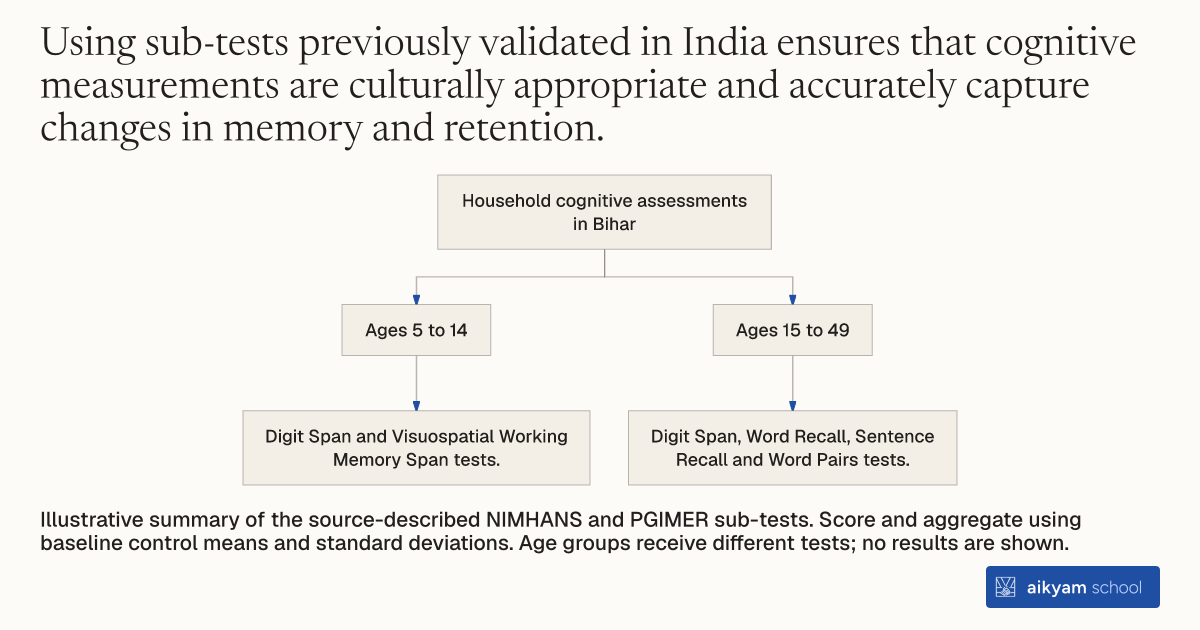
Household cognitive assessments in Bihar
- Ages 5 to 14
- Digit Span and Visuospatial Working Memory Span tests.
- Ages 15 to 49
- Digit Span, Word Recall, Sentence Recall and Word Pairs tests.
Illustrative summary of the source-described NIMHANS and PGIMER sub-tests. Score and aggregate using baseline control means and standard deviations. Age groups receive different tests; no results are shown.
See source →How
When to use
Poor children and adults in developing regions often suffer from micronutrient deficiencies like iron deficiency anemia, which can impair memory and learning. Public health programs need reliable tools to evaluate whether nutritional interventions improve cognitive performance across rural populations. Administering validated neuropsychological tests measures memory, retention, and executive function directly in household settings.
Assess child and adult cognitive function using standardized memory and neuropsychological test modules during household surveys.
- Select validated cognitive sub-tests from the National Institute of Mental Health and Neuro Sciences (NIMHANS) battery and the Post Graduate Institute of Medical Education and Research (PGIMER) memory dysfunction battery.
- Administer the Digit Span test and Visuospatial Working Memory Span Test to children aged 5 to 14 years to evaluate short-term memory and visual retention.
- Administer the Digit Span Test, Word Recall Test, Sentence Recall Test, and Word Pairs Test to adults aged 15 to 49 years during individual field interviews.
- Score performance across sub-tests covering immediate sentence recall, delayed word list recall, and retention of word pairs.
- Aggregate individual sub-test scores into standardized cognition scores using baseline control group means and standard deviations.
Why it works
Standardizing scores against baseline control means allows field teams to compare cognitive gains across different age groups and treatment arms.
Example
Survey staff administered NIMHANS and PGIMER cognitive modules to 10,711 children and 13,418 adults across study villages in Bhojpur district, Bihar. Cognition scores in double-fortified salt sales villages were 0.040 standard deviations higher than control villages, though the gain was not statistically significant after adjusting for multiple testing.
About the study
Participants
10,711 children aged 5 to 14 years and 13,418 adults aged 15 to 49 years tested across 400 rural villages in Bhojpur district, Bihar.
Study Design
Field survey teams administered age-appropriate NIMHANS and PGIMER sub-tests during household endline surveys across sales treatment, free distribution, and control villages to measure cognitive impact.
Results
In the sales experiment, overall standardized cognition scores showed a modest point estimate of +0.040 standard deviations (95% CI: +0.003 to +0.077 SD, Q-value = 0.113), while in the free distribution experiment overall cognition showed no significant change (-0.009 SD, 95% CI: -0.062 to +0.044 SD).