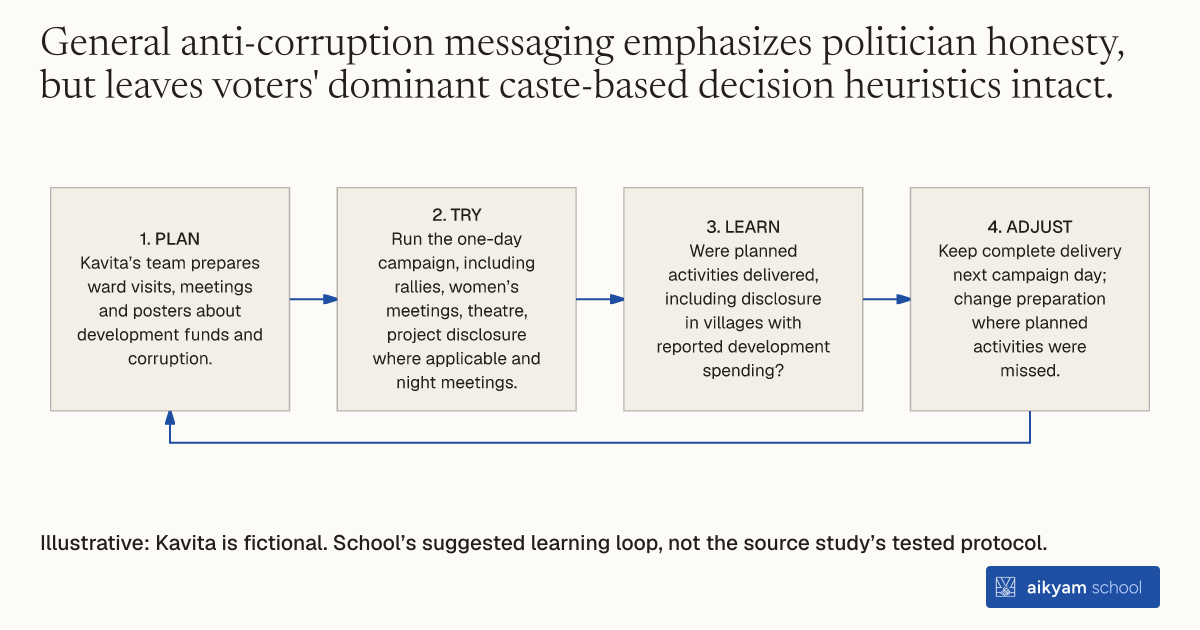
Try, learn and adjust
Check anti-corruption campaign delivery
- Plan: Kavita’s team prepares ward visits, meetings and posters about development funds and corruption.
- Try: Run the one-day campaign, including rallies, women’s meetings, theatre, project disclosure where applicable and night meetings.
- Learn: Were planned activities delivered, including disclosure in villages with reported development spending?
- Adjust: Keep complete delivery next campaign day; change preparation where planned activities were missed.
Illustrative: Kavita is fictional. School’s suggested learning loop, not the source study’s tested protocol.
See source →School’s suggested learning loop, not a tested source procedure. Observe activity coverage. The source reports no significant effect on overall turnout or support for candidates ranked most corrupt.
How
When to use
Low-income voters in developing democracies frequently face political corruption and misappropriation of public development funds. A non-partisan anti-corruption campaign attempts to mobilize rural citizens to hold crooked legislators accountable and vote for clean candidates. It applies in electoral settings where corrupt politicians exploit voter information gaps and lack of explicit guidance about candidate probity.
Deploy a two-person non-partisan campaign team to execute a one-day voter mobilization program in targeted rural villages prior to an election.
- Conduct morning door-to-door visits in every ward to inform elderly, sick, and marginalized residents about scheduled campaign activities.
- Display posters in public village areas detailing how corrupt politicians divert public development funds.
- Hold about three ward-level meetings where villagers identify local infrastructure problems like sewage, roads, and health services.
- Organize an afternoon children's rally with slogan chanting and conduct targeted meetings with local women's self-help groups.
- Convene a main village-level meeting and lead wall-writing activities with villagers to reinforce non-partisan campaign slogans.
- Perform an early evening street puppet show illustrating an impoverished village suffering under a corrupt legislator who pockets development funds.
- Disclose specific project expenditures in villages where incumbent legislators spent discretionary development funds, and hold night meetings for returning daily laborers.
Why it works
Because voters lack verifiable candidate-level corruption data, priming alone fails to shift electoral support away from corrupt politicians.
Example
During the 2007 Uttar Pradesh state assembly election, an NGO delivered the one-day campaign across 32 polling-station clusters in central India, reading aloud completed project lists in villages with discretionary legislator spending. The intervention produced no statistically significant changes in voter registration, overall turnout, or the vote share of candidates ranked most corrupt by local journalists.
About the study
Participants
The trial evaluated 32 clusters of 12 to 20 rural villages across Lalitpur, Bahraich, and Sitapur districts in Uttar Pradesh, India, using Election Commission data across treated and control polling units.
Study Design
Researchers implemented a randomized cluster field experiment stratified by jurisdiction and discretionary legislator fund spending, using instrumental variables to correct for village-unit selection rules and evaluating candidate corruption via pre-election journalist polls.
Results
The campaign produced no significant changes in voter registration or turnout (turnout point estimate +0.7% overall; p > 0.1), and caused no reduction in the vote share of candidates ranked most corrupt by local journalists (treatment interaction point estimate +0.103; p > 0.1).